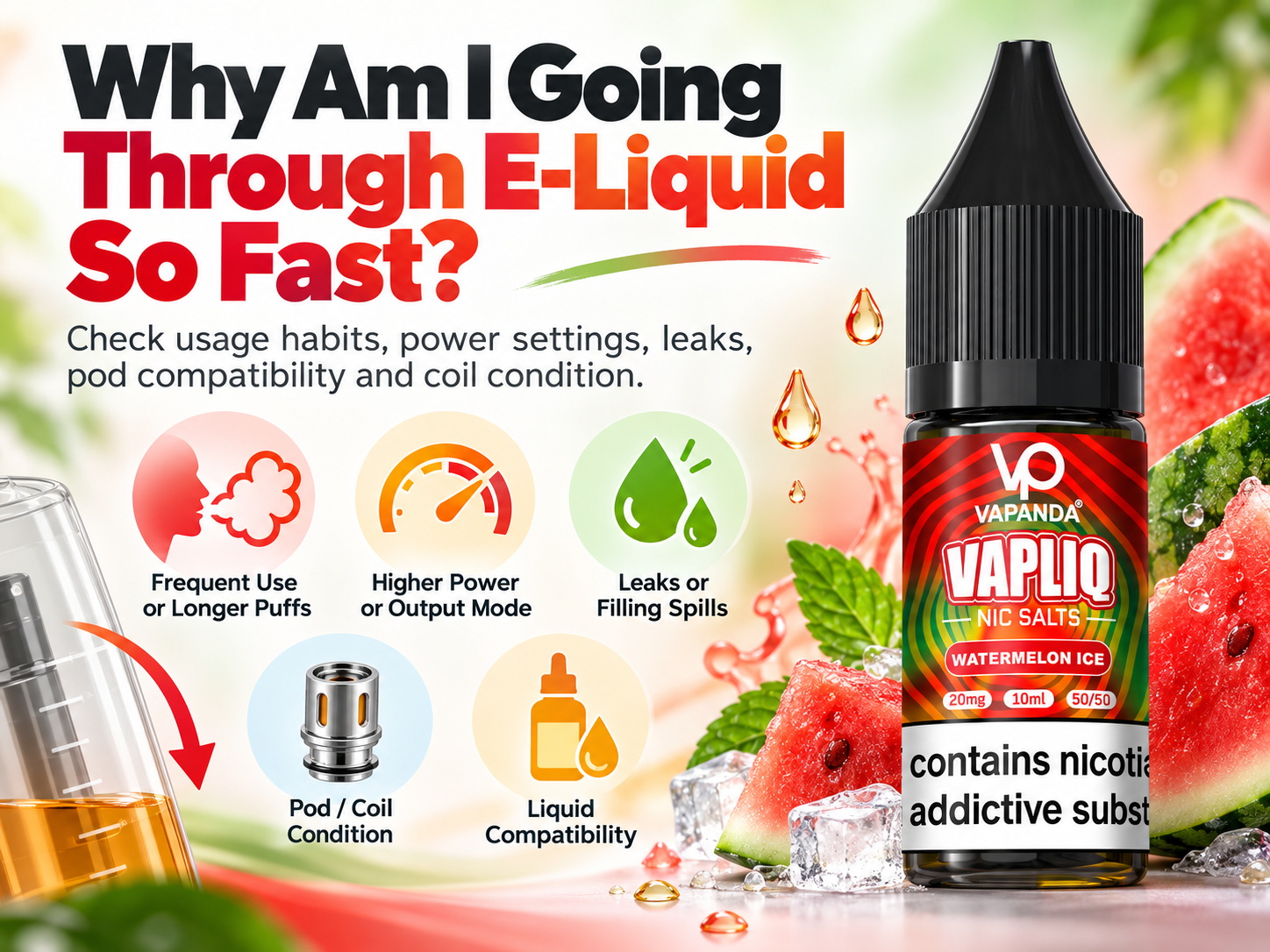
Why Am I Going Through E-Liquid So Fast?
E-liquid can run out quickly because a device produces more aerosol, because it is used more often, or because liquid escapes through a leak or filling spill. These causes need different checks. A falling level alone does not prove a defective pod or an overheating coil.
It also helps to separate liquid consumption from coil life. A bottle can empty while a coil still works normally, and a damaged wick can produce a burnt taste even with liquid left in the reservoir.
Normal consumption or avoidable loss?
| What changed | Possible explanation | Useful first check |
|---|---|---|
| More use or longer activations | More liquid is converted into aerosol | Compare use with your previous routine |
| A new mode, coil or device | The setup has different output and liquid demand | Check the exact coil and mode instructions |
| Wet seams, fill port or device base | A leak, spill or condensation may be present | Locate the liquid with the device switched off |
| Gurgling or droplets in the mouthpiece | Liquid may be entering the airflow path | Stop and follow the flooding procedure for that model |
| Persistent burnt taste | Wick damage, low liquid or supply problems | Stop rather than trying to use up the reservoir |
These clues guide inspection; they do not establish a diagnosis by themselves.
Seven checks for unexpectedly fast liquid use
1. Compare like with like
A change from a compact low-output pod to a higher-output tank can change how quickly liquid is used. The same bottle lasting fewer days is not automatically evidence of waste.
Compare the device, coil, output setting and frequency of use together. If you keep a record, note liquid added, spills, pod changes and the selected mode during your normal routine. Do not increase use to run a consumption test.
As a simple accounting example, a 10 ml bottle used over five days represents an average of 2 ml per day before allowing for spills or discarded liquid. That figure describes the record, not a recommended intake or a health limit.
2. Check output and mode changes
Higher-output settings can convert more liquid into aerosol under otherwise comparable conditions. However, the result also depends on the coil, airflow, liquid supply and activation time.
Use the exact coil's recommended operating range. On an adjustable device, return to the supported setting if an accidental change occurred. Do not lower power below the specified range simply to stretch a bottle: an unsuitable setting can create other performance problems.
Power is also relevant to emissions, not just cost. A study of adjustable-power devices found increased carbonyl emissions when the tested coils were operated above their recommended power ranges. Its results do not provide a universal safe wattage for other products.
3. Check activation time and frequency
More activations generally mean more liquid use. Longer activations can also increase the energy delivered to a coil when output is otherwise unchanged.
Avoid repeatedly activating a hot device or continuing through a dry or burnt taste. Follow its normal-use and cutoff instructions. There is no universal rule that every person or device should use a 2–3 second puff followed by a 3–5 second break.
The puffing-behaviour research cited here measured differences between devices and use patterns. It does not establish an optimal inhalation schedule for modern pods.
4. Inspect for filling spills and leaks
Before refilling a user-refillable pod, identify the correct fill port. Filling the central airflow passage, exceeding the stated fill level or leaving a stopper open can release liquid outside the reservoir.
With the device off, check the fill closure, accessible seams and removable pod base. Clean permitted external surfaces and watch for recurrent wetness during normal handling. Do not keep topping up a pod that continues to leak.
Small droplets in a mouthpiece can be condensation. Persistent loss from a seam or filling port needs a different check. Aspire's troubleshooting guidance distinguishes filling errors, damaged seals and condensation in its examples; exact cleaning and filling instructions remain model-specific.
If liquid may have entered the battery section or charging port, stop using and charging the device and seek manufacturer support.
5. Verify liquid compatibility
PG/VG proportions affect viscosity, but there is no single ratio appropriate for every pod. Check the liquid specification for the exact cartridge and coil, including any manufacturer restrictions.
Poor liquid delivery may contribute to dry hits or flooding. It does not justify a blanket claim that thicker liquid always runs out faster or that all pod systems require 50/50 liquid.
Nicotine salts versus freebase nicotine and PG/VG ratio are different properties. A nicotine-type guide does not replace the device's viscosity guidance. Do not increase nicotine strength just to reduce the volume used, and do not dilute a finished liquid with water, oils or household ingredients.
6. Prepare new coils and pods as instructed
For a refillable system, follow its wetting or priming procedure and wait for the specified time before activation. A universal five- or ten-minute instruction may not suit every design.
Do not fire a dry coil. Avoid using unpowered inhalation as a generic priming technique: draw-activated devices can switch on, and pulling liquid into the airway can cause flooding.
Keep liquid above the minimum level specified for the coil's supply openings. Priming reduces one cause of premature wick damage; it does not guarantee a particular lifetime or daily liquid saving.
7. Assess condition rather than replacing by flavour name
Replace a pod or coil according to its instructions and condition. Persistent burnt taste, damage, poor operation after the permitted checks or a manufacturer's replacement indication matter more than a calendar interval alone.
Pod replacement cannot be scheduled reliably by flavour category alone. A dessert, fruit or menthol label does not reveal the complete formulation, and residue varies with ingredients and operating conditions.
Clean accessible surfaces when needed and follow the storage instructions. Heat can affect liquid behaviour and seals, but it should not be used to explain substantial loss from an intact sealed reservoir without checking for leakage or device damage.
When to stop troubleshooting
Stop using a cracked pod, a persistently leaking reservoir or a device with abnormal heat, swelling or uncontrolled activation. A replacement consumable may resolve a pod-specific fault, but it cannot confirm that electronics affected by liquid remain safe.
Do not dry-fire, puncture or refill a sealed disposable to recover its remaining liquid. Follow the manufacturer's replacement and disposal instructions. In the United States, EPA guidance directs e-cigarette waste to household hazardous waste collection; elsewhere, use an appropriate local service.
For related symptoms, see the coil troubleshooting guide and tank maintenance guide.
Frequently asked questions
Why is liquid running out with no obvious leak?
First compare use, output mode and coil changes. Then check for filling spills and small recurring losses around closures. No visible leak does not prove there is one, or prove the liquid is evaporating during storage.
Will lower wattage always save liquid?
It may reduce aerosol production in some setups, but only settings supported by the exact coil should be used. A lower number is not automatically a better operating point.
Does cleaning guarantee lower consumption?
No. Cleaning can address accessible residue and moisture. It does not change the normal liquid demand of the heating system or repair a failed seal.
Should I switch to a 50/50 liquid?
Only if that formulation is appropriate for the exact pod. Follow compatibility information rather than treating one ratio as universal.
Is a burnt taste a sign that all the liquid is gone?
Not necessarily. Liquid supply or wick damage can cause burnt taste before the reservoir is empty. Stop and follow the model's troubleshooting or replacement procedure.
Adult use notice
This information is for adults of legal vaping age. Nicotine is addictive, and vaping is not risk-free. Adults who do not use tobacco or nicotine products should not start. Keep liquid and devices away from children and pets. Follow product instructions and local laws.