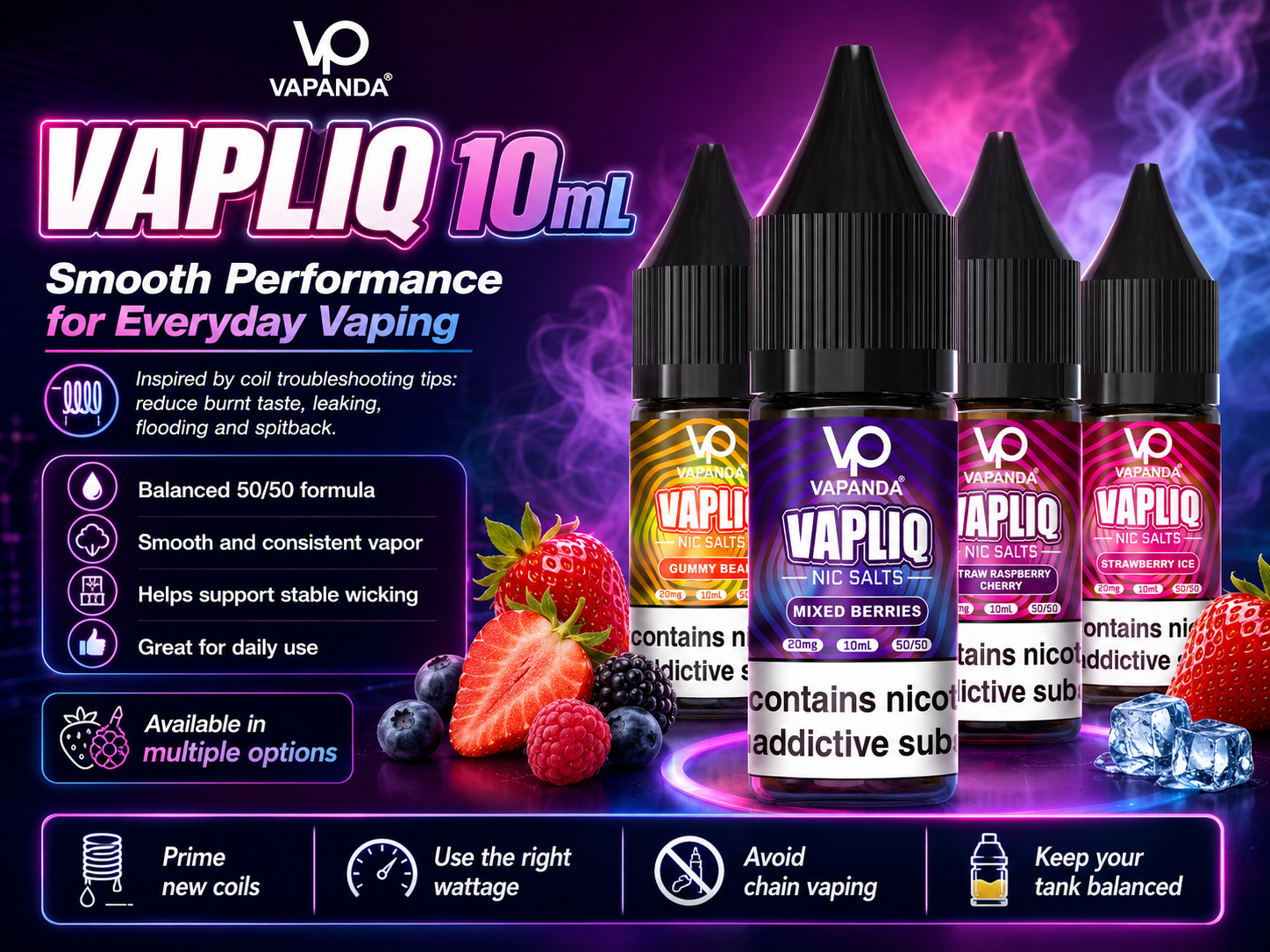
A burnt taste, leaking tank, or hot liquid reaching your mouth are some of the most common problems vape users experience. Many people assume the device or tank is faulty, but in most cases the issue comes from an imbalance between the coil, e-liquid, wattage, airflow, and vaping habits.
A vape coil is a small component, but it has to perform several tasks at the same time: heating efficiently, absorbing e-liquid, producing vapor, and maintaining proper airflow. When one part of this system becomes unbalanced, problems such as dry hits, flooding, weak flavor, and short coil lifespan can appear.
This guide explains how vape coils work, why they fail, and how to diagnose common coil problems.
Disclaimer: This article is for adults of legal smoking age (21+) only and provides general device maintenance information. It does not provide medical advice.
What Is a Vape Coil and How Does It Work?
A vape coil is the heating component inside a tank or pod system that converts e-liquid into vapor.
Most modern coils contain three main parts:
- Heating element: A wire or mesh structure that heats when electricity passes through it.
- Wicking material: Usually cotton that absorbs and delivers e-liquid to the heating area.
- Coil housing: The structure that controls airflow and liquid movement.
When the device is activated:
- Electricity heats the coil element.
- Heat transfers to the saturated cotton wick.
- E-liquid around the heating area vaporizes.
- Airflow carries vapor through the chimney or mouthpiece.
A properly working coil requires the right balance between heat and liquid supply. Too much heat with insufficient liquid causes a burnt hit. Too much liquid with insufficient vaporization causes flooding, popping, and leaking.
The Main Factors That Affect Coil Performance
1. Coil Resistance and Wattage
Coil resistance determines how much power the coil needs.
Low-resistance coils (approximately 0.15Ω–0.4Ω)
Usually designed for sub-ohm vaping:
- Require higher wattage
- Produce more vapor
- Need stronger airflow
- Require faster e-liquid absorption
Higher-resistance coils (approximately 0.8Ω–1.2Ω)
Common in pod systems:
- Operate at lower wattage
- Produce less vapor
- Often work better with thinner e-liquids
Using a wattage setting outside the coil’s recommended range can shorten coil life. More power does not always mean better performance. The ideal setting is where heat production and liquid delivery remain balanced.
2. Wicking Speed
The cotton inside a coil acts as a small liquid delivery system.
During every puff, the wick must replace the e-liquid that evaporates from the heating surface. If evaporation happens faster than the wick can refill, the cotton becomes partially dry and overheats.
This creates a dry hit, usually recognized by a harsh burnt taste.
3. Mesh Coils vs Traditional Wire Coils
Many modern devices use mesh coils because they heat more evenly.
Mesh coils:
- Larger heating surface
- More consistent temperature distribution
- Faster vapor production
- Fewer concentrated hot spots
Traditional wire coils can still perform well, but residue buildup over time may create uneven heating areas.
Why Does My Vape Taste Burnt?
A burnt vape taste usually means the coil is producing more heat than the wick can support.
Common causes include:
| Problem | What Happens | Solution |
|---|---|---|
| Wattage too high | Heat exceeds liquid supply | Reduce wattage |
| Chain vaping | Wick cannot recover between puffs | Allow short breaks |
| Thick e-liquid | Liquid moves slowly through cotton | Use suitable VG/PG ratio |
| New coil not primed | Dry cotton burns immediately | Saturate coil before use |
| Low e-liquid level | Wick cannot absorb enough liquid | Refill before empty |
VG and PG: Why E-Liquid Thickness Matters
E-liquid thickness has a major effect on coil performance. Understanding the differences between freebase e-liquid and nicotine salt formulas can help users choose liquids that match their coil design and vaping style.
For a deeper comparison of different e-liquid formats, see this guide: E-Liquid vs Nic Salts: How They Differ in Real EU Vaping Use
Vegetable Glycerin (VG)
VG is thicker and produces denser vapor.
Advantages:
- Smooth vapor
- Larger clouds
- Reduced throat sensation
Disadvantage:
- Slower movement through cotton
Propylene Glycol (PG)
PG is thinner and carries flavor effectively.
Advantages:
- Faster wicking
- Stronger flavor delivery
- Better for smaller coils
Disadvantage:
- Less vapor production compared with high-VG liquids
General matching:
Sub-ohm coils (below 0.5Ω):
Often work better with:
- 70VG/30PG blends
- Higher VG liquids
Pod coils (around 0.8Ω and above):
Often perform better with:
- 50VG/50PG blends
- Medium-thickness liquids
The best choice depends on the specific coil design and manufacturer recommendations.
Can a Burnt Coil Be Fixed?
It depends on whether the cotton is damaged.
If the issue was temporary, such as taking a puff when the tank was almost empty, allowing the coil to fully absorb liquid may improve performance.
However, once cotton has been scorched, the damage is usually permanent.
Signs a coil needs replacement:
- Burnt taste remains after refilling
- Vapor production drops noticeably
- Flavor becomes harsh or unusual
- The coil smells burnt even when not in use
Adding more e-liquid cannot restore burned cotton fibers.
Why Do Vape Coils Burn Out Quickly?
Coil lifespan depends on several factors.
1. Poor Coil Priming
A new coil contains dry cotton. Before use:
- Add e-liquid to the exposed cotton areas.
- Install the coil.
- Fill the tank or pod.
- Wait several minutes before vaping.
Activating a completely dry coil can permanently damage the wick.
2. Excessive Power
Running a coil above its recommended wattage increases heat stress.
A coil rated for 25W–35W may produce more vapor at 40W, but the higher temperature can reduce lifespan and increase the chance of dry hits.
3. Sweetened E-Liquids
Some sweetened liquids leave residue on the heating surface.
Over time, buildup may:
- Reduce flavor quality
- Slow liquid contact
- Darken the coil surface
Users who prefer very sweet flavors may notice shorter coil lifespan.
Why Does My Vape Spit or Leak?
Burnt hits usually mean not enough liquid.
Spitting and leaking usually mean too much liquid.
This is known as flooding.
When excess e-liquid collects inside the coil chamber:
- The coil cannot vaporize everything quickly enough.
- Liquid droplets remain in the airflow path.
- The device may crackle, pop, or leak.
Common Causes of Flooding
Strong, Fast Draws
Pulling too aggressively can force extra liquid into the coil chamber.
A slower, smoother inhale often improves performance.
Wattage Too Low
If power is too low:
- Liquid enters faster than it can vaporize.
- The coil chamber becomes flooded.
- Popping sounds become more common.
Temperature Changes
Pressure changes can affect tanks and pods.
Examples:
- Leaving a device in a cold environment
- Moving it into a warm room
- Carrying it through altitude changes
These conditions may increase leakage risk.
Overfilling
A small amount of air space inside a tank helps maintain pressure balance. Filling completely to the top may increase flooding problems.
Quick Coil Diagnosis Chart
| Symptom | Possible Cause | First Step |
|---|---|---|
| Burnt taste immediately after installing coil | Dry cotton | Replace coil and prime correctly |
| Gurgling sound | Excess liquid | Remove extra liquid |
| Hot droplets in mouth | Flooded coil | Check wattage and airflow |
| Weak flavor | Residue buildup or aging coil | Replace coil |
| Leakage around tank base | Damaged seal or excess liquid | Check seals |
How to Make Vape Coils Last Longer
Simple habits can significantly improve coil lifespan:
- Stay within the recommended wattage range.
- Prime every new coil before use.
- Avoid repeated long puffs without breaks.
- Match e-liquid thickness to coil design.
- Keep tanks upright during storage.
- Clean condensation regularly.
- Replace damaged seals and O-rings.
Choosing the right device format can also reduce common coil problems. Different vape systems use different coil structures, airflow designs, and power requirements. Learning about these differences can help users when comparing different vape setups.
A vape coil is not simply a disposable heating wire. It is a system that depends on the relationship between heat, liquid movement, and airflow.
When those three factors are balanced, coils perform better, flavor stays more consistent, and common problems such as burnt hits, leaks, and spitback become much easier to prevent.