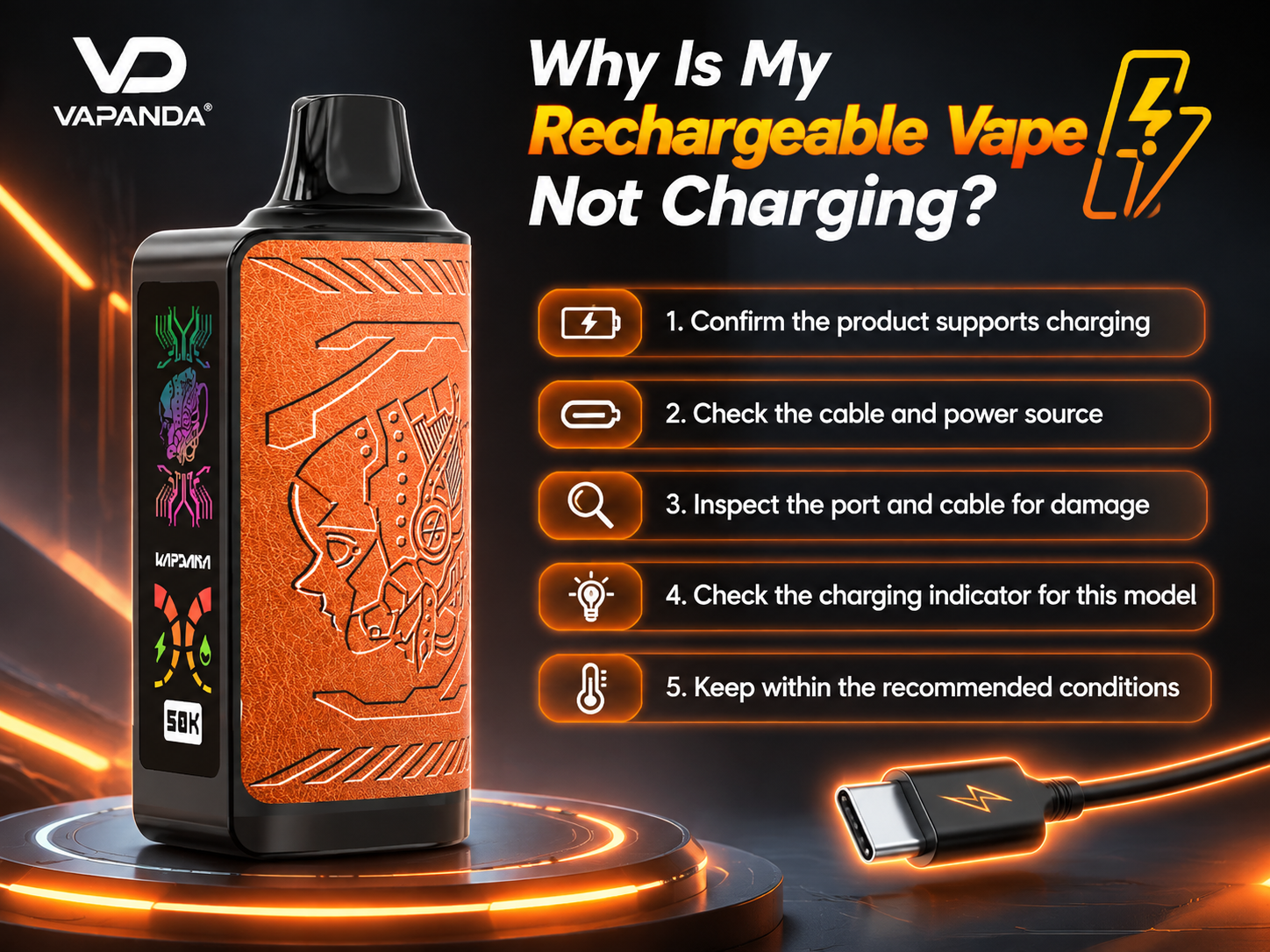
Why Is My Rechargeable Vape Not Charging?
A vape may fail to charge because of the charging setup, a damaged connection, a protection state or a battery or circuit fault. A blank screen or blinking light alone cannot identify which explanation applies.
Before trying a cable or power source, check the device's condition. If it is swollen, unusually hot, deformed, wet around the charging area, smoking or giving off an electrical burning smell, stop using and charging it. Do not reconnect it to see whether the problem clears.
What the symptom can tell you
| Symptom | Possible explanations | Appropriate next step |
|---|---|---|
| No light or display | Normal display behaviour, no charging input or a device fault | Check the exact model's charging instructions |
| Blinking while connected | A charging indication or fault code | Read the model-specific indicator guide |
| Starts charging, then stops | Normal termination, a poor connection or a fault | Check the instructions and accessible condition |
| Connector is loose or damaged | Port or cable damage | Stop; do not hold it at an angle to make it charge |
| Unexpected heat, swelling or smoke | A potentially hazardous battery or electrical fault | Stop troubleshooting and keep clear if necessary |
| Full indication but no aerosol | An activation, liquid, coil or electronics problem | Follow the operating guide rather than repeatedly recharging |
These are possible explanations, not diagnostic codes shared by every vape.
1. Confirm the product supports charging
Find the exact model and its instructions. Do not infer charging support from a similar-looking product or an opening that resembles a USB-C port.
A rechargeable sealed disposable can accept more battery energy while retaining a non-refillable reservoir and non-replaceable coil. A non-rechargeable product must not be modified or connected to improvised wiring. For the distinction, see rechargeable vapes and non-rechargeable disposables.
If the charging instructions are absent, ask the manufacturer or responsible supplier for them before connecting power.
2. Check the intended cable and power source
Read the specified input voltage and current and identify the supplied or recommended charging equipment. The USB-IF guidance on cables and connectors distinguishes connector and cable capabilities from those of the connected product. USB-C does not automatically establish fast charging or USB Power Delivery support.
The maximum wattage printed on a charger is not, by itself, the power a vape will receive. Equally, a matching plug does not prove a supported charging arrangement. Follow the device's actual input specification and equipment instructions.
For an undamaged device in the permitted conditions, check that the intended power source is switched on and that the approved cable is seated normally. If the manufacturer allows an alternative cable or power source, a known-working approved replacement can help identify a failed accessory. Do not experiment with unspecified voltages or altered leads.
3. Inspect accessible parts with power disconnected
Look for frayed cable insulation, a bent or loose plug, a distorted port, visible moisture or damage to the housing. Do not force a connector into a socket or continue using a cable that only works when bent.
Keep cleaning to the accessible external surfaces and procedures allowed by the manufacturer. Do not insert improvised tools or liquid cleaner into a port, straighten contacts or open a sealed battery assembly.
Drying the outside does not establish that a device with suspected liquid inside is suitable for charging again. Obtain manufacturer guidance for moisture or ingress.
4. Interpret the charging indication for this model
Some models use a steady light, some blink and others show a battery symbol or percentage. Displays may also switch off while charging continues.
Check the meaning of the exact colour, symbol or flash pattern in the manual. A guide for another model cannot confirm that the battery is merely empty, fully charged or faulty. If the indicator behaves differently from the instructions, disconnect and seek support rather than inventing an error-code explanation.
5. Consider the operating conditions
Charging may stop as part of normal control or because a device is outside its permitted temperature range. An interrupted charge does not prove that a particular protection circuit activated correctly.
Follow the manufacturer's environmental limits. Allow ordinary cooling only as instructed; do not use a freezer, water, a heater or a hairdryer to change the battery temperature. A device that was excessively hot or otherwise damaged needs assessment, not just another attempt after it cools.
6. Do not try to revive an unresponsive battery
A deeply discharged device may respond differently from one with charge remaining, but a blank screen does not prove that recovery charging is appropriate.
Follow only the charging procedure and limits specified for that product. Do not extend the time indefinitely, leave it connected overnight, apply power directly to a cell or bypass a protection circuit. If the device does not respond as described, stop repeated attempts and contact the supplier.
7. Separate charging failure from short runtime
A device can charge normally yet have limited runtime because of its settings, battery condition or intended capacity. Conversely, battery indication does not establish that a coil or liquid supply remains usable.
Do not recharge repeatedly to address an empty sealed reservoir or persistent burnt taste. Follow the model's consumable-replacement or end-of-life guidance. The battery performance article explains the difference between stored charge and heating output.
Charging and disposal precautions
The FDA's battery guidance recommends observing a charging vape on a clear, flat surface away from combustible materials and extreme temperatures. Use the specified equipment and avoid unattended or overnight charging.
Only operate while connected to power if the manufacturer explicitly supports that use. Do not handle a smoking or burning device; move away, keep others clear and contact emergency services. Disconnect power only if it is safe to do so.
Use a local collection route that accepts vaping products and their batteries. In the United States, the EPA directs e-cigarettes to household hazardous waste collection, rather than ordinary household rubbish or recycling. Check the appropriate local arrangements elsewhere.
Frequently asked questions
Can I leave an empty vape charging until it wakes up?
Follow only the model's documented charging procedure. Do not leave an unresponsive device connected indefinitely or attempt direct battery recovery.
Does blinking mean the charger is wrong?
Not necessarily. Blink meanings vary. Check the exact model's indicator guide and approved equipment.
Is every USB-C phone charger unsuitable?
Compatibility cannot be decided from the product category alone. Use the equipment and input arrangement specified for the vape.
Should I wiggle the plug to make charging start?
No. A loose, damaged or intermittent connection needs checking rather than being held under strain.
Can I repair the charging circuit myself?
Do not open or modify a sealed battery unit. Ask the manufacturer about authorised service or replacement.
Adult use notice
This information is for adults of legal vaping age. Nicotine is addictive, and vaping is not risk-free. Adults who do not use tobacco or nicotine products should not start. Keep devices and liquids away from children and pets, and follow product instructions and local laws.