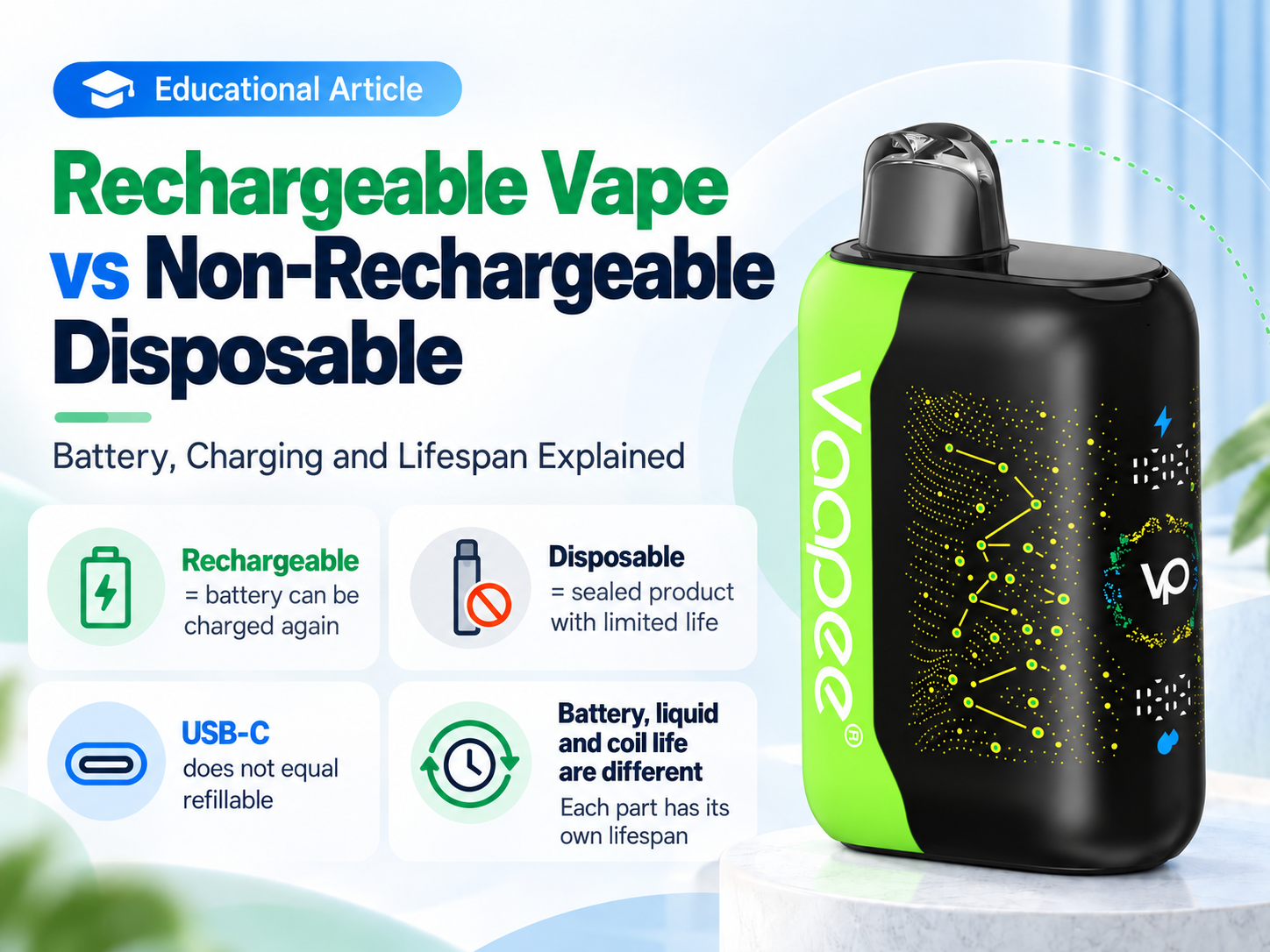
Rechargeable High-Puff Vapes and Non-Rechargeable Disposables
A rechargeable high-puff vape can receive another battery charge during its intended life. A non-rechargeable disposable relies on the charge supplied at manufacture. That is a battery difference, rather than a complete description of how either product is used or discarded.
A rechargeable device can still be disposable if its liquid reservoir is sealed and its coil cannot be replaced. Charging restores battery energy; it does not restore depleted liquid, repair a worn wick or make a sealed product refillable.
Three features to distinguish
| Feature | What it describes | What to check |
|---|---|---|
| Rechargeable | The battery can receive additional charge | Charging instructions and specified input |
| Refillable | The reservoir is designed for user refilling | A designated fill port and filling procedure |
| Replaceable pod or coil | A supported component can be changed | Exact compatible part numbers |
These features are independent. A USB-C port confirms neither a refill port nor a replaceable heating assembly. Do not open, puncture or refill a sealed reservoir.
How the device types compare
| Device type | Battery charging | Liquid access | Typical end-of-life decision |
|---|---|---|---|
| Non-rechargeable sealed disposable | Not supported | Sealed | Replace the device when liquid or usable charge is exhausted |
| Rechargeable sealed disposable | Supported as specified | Sealed | Replace when liquid, coil or another non-serviceable component reaches its limit |
| Rechargeable refillable system | Supported as specified | Refillable | Refill and replace supported consumables while the device remains serviceable |
This is a description of common designs, not a ranking of safety, reliability or legal availability. A rechargeable battery alone does not establish that a product qualifies as reusable under local rules.
Why many high-puff devices can be recharged
A device with a larger liquid supply may need more electrical energy over its total life than one compact battery charge can provide. Allowing repeated charging separates the battery's runtime between charges from the reservoir's usable life.
That distinction matters when a product stops producing aerosol. A low battery may need charging, but an empty reservoir or damaged coil needs a different response. Recharging repeatedly will not resolve a persistent burnt taste or an exhausted sealed liquid supply.
What a puff rating tells you
A puff rating is a manufacturer's capacity claim under particular test conditions. It is not the number of activations every person will obtain.
Puff duration, output mode, liquid capacity and heating design can affect usable life. A meaningful comparison therefore needs the test method, the operating mode and the end point used to count puffs.
Research measuring e-cigarette puffing behaviour found differences between the products studied. Those older devices do not establish the real-world life of a particular modern high-puff product. The useful lesson is to compare test conditions, rather than treating a product name as a measurement.
Battery capacity is not coil power
Battery capacity in mAh describes stored charge under specified conditions. Coil output power is usually expressed in watts. Charging input is another specification again.
A larger mAh figure, a charging connector or a high puff rating does not by itself prove stronger output, faster charging or longer-lasting flavour. Compare the full device specification. For a fuller explanation, see how battery design affects vape performance.
USB-C does not automatically mean fast charging
USB-C identifies a connector system. Charging performance depends on the device, cable, power source and supported power arrangement. The USB-IF guidance on cables and connectors distinguishes cable capabilities from the capabilities of connected products.
Check the vape's permitted input voltage and current, its supplied or recommended charging equipment and any stated charging time. A cable that fits does not prove that every charger or charging mode is suitable.
Do not assume that USB Power Delivery, every USB-C-to-USB-C cable or a particular fast charger is supported merely because the device has a USB-C socket. If the instructions are unclear, ask the manufacturer before charging.
Charging and device condition
Use the specified charging equipment and keep the port dry. Charge where you can observe the device, away from combustible materials and extreme temperatures; avoid charging overnight. These are consistent with the FDA's vape battery guidance.
Do not use the device while it is connected to power unless its instructions explicitly permit that operation.
Stop using and charging a device with swelling, damaged wiring or a connector, abnormal heat, uncontrolled activation, or suspected liquid inside the electronics. Do not dismantle a sealed battery assembly. If it smokes or burns, keep clear and contact emergency services.
When a rechargeable device reaches its limit
A sealed device may need replacement because its liquid is depleted, its wick or coil has deteriorated, or its battery or electronics are damaged. The ability to recharge does not remove these limits.
Use the local collection route for vaping products and their batteries. In the United States, the EPA advises taking e-cigarettes to household hazardous waste collection, rather than placing them in household rubbish or ordinary recycling. Elsewhere, check the collection service that accepts these products locally.
A practical specification checklist
Before using a device, locate:
- The exact model and intended charging equipment.
- The input voltage and current, rather than just the port name.
- Whether the liquid system is sealed or refillable.
- Whether the pod or coil is replaceable and which part fits.
- The meaning of selectable operating modes.
- The test conditions behind any puff rating.
- The manufacturer's stop-use and disposal instructions.
Frequently asked questions
Can a rechargeable vape still be disposable?
Yes. A device with a rechargeable battery can still have a sealed reservoir and a non-replaceable coil. It may need to be discarded when those components reach the end of their intended life.
Does charging add more liquid or repair a burnt coil?
No. Charging restores battery energy. A persistent burnt taste or depleted liquid supply requires the response specified for the pod, coil or sealed device.
Does USB-C make the device more powerful?
Not by itself. Coil output depends on the heating system and control electronics, while USB-C describes the charging connection.
Can I refill a rechargeable sealed device?
Only a reservoir explicitly designed for user refilling should be filled. Do not use a charging port as evidence that a sealed device can be opened.
How long will one battery charge last?
It depends on the device, battery condition, output setting and use. A total puff rating is not a measure of runtime between charges.
Adult use notice
This information is for adults of legal vaping age. Nicotine is addictive, and vaping is not risk-free. Adults who do not use tobacco or nicotine products should not start. Keep devices and liquid away from children and pets, and follow product instructions and local laws.