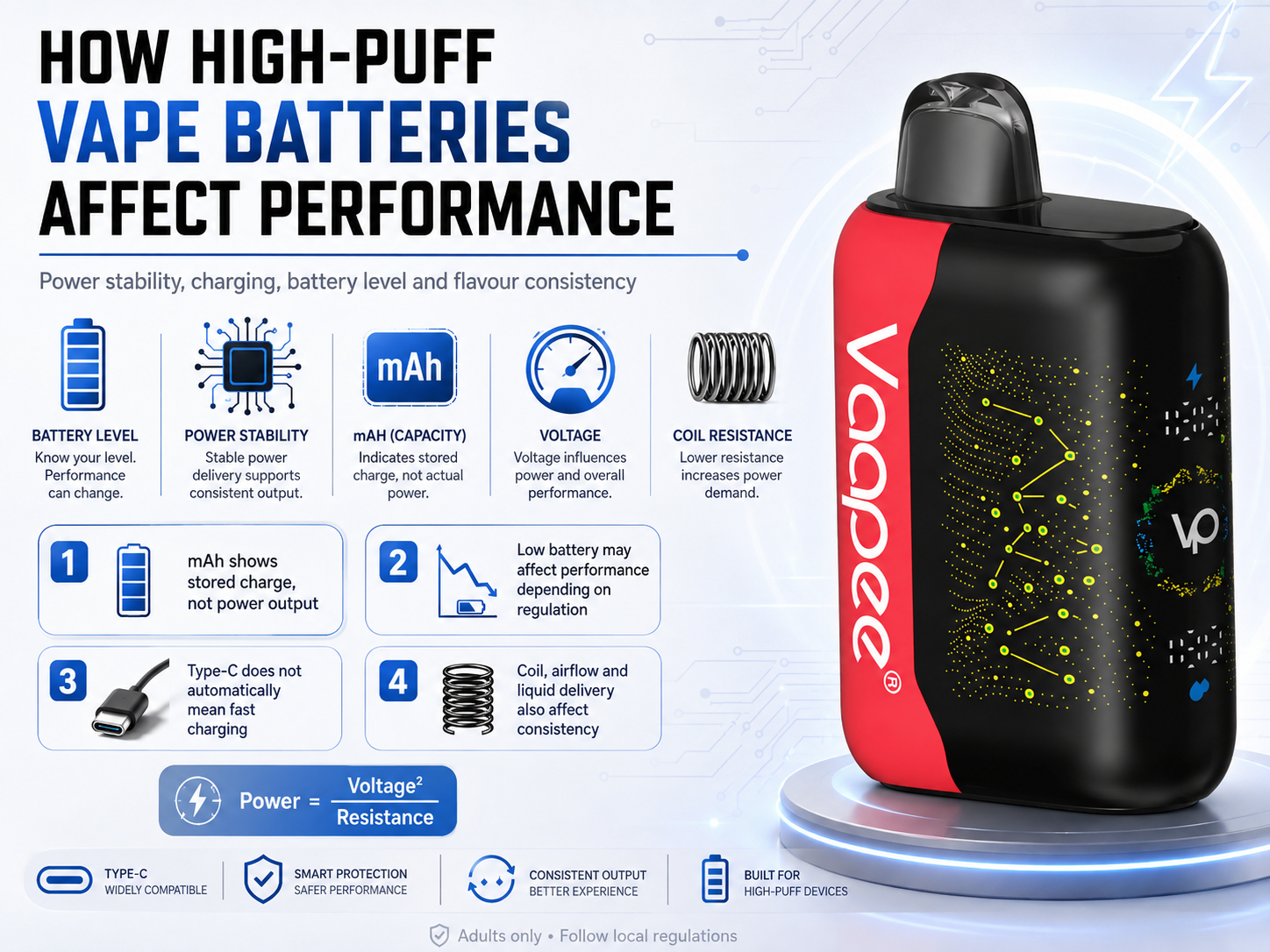
How High-Puff Vape Batteries Affect Performance and Power Stability
A high-puff vape battery affects how reliably the coil receives energy, but battery capacity alone does not determine vapour output, flavour or puff count.
The result depends on the complete system: cell condition, voltage, coil resistance, control electronics, airflow, e-liquid delivery and the selected power mode. A well-regulated device may keep its output relatively consistent through much of the charge cycle, while another device may reduce power as the battery approaches its low-voltage cutoff.
The practical lesson is simple: mAh tells you about stored charge, not how powerful or stable a vape must be.
Battery Performance at a Glance
| Question | Practical answer |
|---|---|
| Does a larger mAh rating mean more power? | No. Capacity and output are different specifications. |
| Does low battery always make a vape weaker? | No. It depends on the regulation circuit and cutoff behaviour. |
| Does USB Type-C mean fast charging? | No. The connector shape does not prove the charging rate. |
| Can higher power produce more aerosol? | Often, but only within the limits of the coil, wick, airflow and liquid supply. |
| Does a rechargeable battery prove a device is reusable? | No. Rechargeable and reusable describe different product features. |
| Can battery behaviour affect flavour consistency? | Yes, but coil condition, wicking and liquid level are often equally important. |
What “Power Stability” Actually Means
Power stability describes how consistently a device supplies electrical energy to its heating system under defined conditions.
A vape coil converts electrical energy into heat. The heat then vaporises liquid held by the wick, forming an aerosol. If the supplied power changes, heating behaviour may also change—but the relationship is not isolated from the rest of the device.
A useful simplified relationship for a resistive heating load is:
Power = Voltage² ÷ Resistance
In practice, modern devices may pulse, limit or regulate the output rather than applying the battery's raw voltage directly. Coil resistance can also change slightly with temperature, and firmware may impose activation-time, current and low-voltage limits.
That is why two products with the same battery capacity can perform very differently.
Battery Capacity, Voltage and Power Are Not the Same
| Specification | What it mainly describes | What it does not prove by itself |
|---|---|---|
| Battery capacity (mAh) | How much electrical charge the cell is rated to store | Heating power, flavour quality or total puff count |
| Voltage (V) | Electrical potential available to the circuit | Actual power delivered to the coil |
| Current (A) | Rate of electrical charge flow | Stable output under every condition |
| Coil resistance (Ω) | Electrical resistance of the heating element | Final temperature without knowing power and cooling |
| Power (W) | Rate at which electrical energy is delivered | Good flavour or safe operation outside the designed range |
| Charging input | Voltage and current accepted while charging | Output power during vaping |
| Control circuit | How charging, activation, output and protection are managed | Performance unless the functions are documented and tested |
What mAh can tell you
A higher mAh rating generally indicates more stored charge under the cell's rated test conditions. All else being equal, more capacity may support more activations between charges.
However, “all else being equal” rarely applies across different high-puff devices. A higher-power mode, lower-resistance coil, longer draw, bright display or inefficient regulation can consume energy faster. Battery ageing and temperature also affect usable capacity.
What mAh cannot tell you
A capacity number does not demonstrate:
- constant power from full charge to cutoff;
- a specific number of puffs;
- stronger flavour;
- greater aerosol output;
- faster charging;
- better battery safety;
- longer total product life.
Puff-count claims are normally estimates produced under a defined machine-puff method. Real-world draw duration, interval, airflow, power mode and cutoff behaviour can produce a different result.
Regulated vs Unregulated Output
Regulated systems
A regulated device uses electronics to manage the energy delivered to the coil. Depending on its design, the circuit may boost, reduce or pulse voltage; limit current; adjust output by mode; and stop activation when the cell reaches a low-voltage threshold.
This can make performance feel more consistent across part of the charge cycle. It does not justify saying that every puff is identical from full charge to empty unless measurements support that claim.
Direct or minimally regulated systems
In a system where coil output follows battery voltage more directly, power may decrease as the cell discharges. The user may notice a slower heat-up or weaker aerosol before the device reaches cutoff.
Most sealed high-puff products provide limited public electrical documentation, so the most accurate wording is often:
The device includes electronic power and charging management.
Claims such as “perfectly constant power to the final puff” require a defined test method and output data at different charge levels.
Does Low Battery Affect Vape Performance?
It can, but low charge is not the only explanation for weak or inconsistent performance.
A regulated device may continue delivering its target output until it reaches a limit. Near that point, it may reduce power, flash a warning, display a low-battery icon or refuse to activate. Another design may show a gradual decline.
Use the following symptoms as diagnostic clues, not absolute proof.
| Symptom | Battery-related possibility | Other common possibilities |
|---|---|---|
| Slower heat-up | Output is being limited near low charge | Flooded coil, cold device or control fault |
| Weaker aerosol | Reduced output or voltage sag | Low liquid, restricted airflow, worn coil or short draw |
| Flavour fades | Lower heating intensity | Coil ageing, wick condition, flavour fatigue or depleted liquid |
| Device cuts off early | Low-voltage protection or battery degradation | Activation timeout, sensor issue or electrical fault |
| Battery percentage drops quickly | Ageing cell, high-power mode or inaccurate display estimate | Long draws, frequent use, cold conditions or display load |
| Burnt taste | Power exceeds liquid delivery or the wick is dry | Low liquid, blocked wicking path, damaged coil or repeated chain use |
A weak draw that improves immediately after charging may point towards charge-related output behaviour. A burnt or dry taste that continues after charging is more likely to involve liquid delivery or coil condition.
For related troubleshooting, see Why High-Puff Vapes Get a Burnt Taste.
How Coil Resistance Changes Battery Demand
Coil resistance helps determine the electrical load placed on the system. At the same applied voltage, a lower resistance draws more current and produces more power in the simplified resistive model.
But resistance alone still does not define performance. Coil surface area, mesh structure, mass, wick contact, airflow and liquid supply affect how quickly heat is produced and removed.
A lower-resistance coil is therefore not automatically better. It must be matched to the circuit and the intended operating range.
How Power Modes Affect Performance
Some high-puff devices offer two or more modes, often described with terms such as normal, boost, turbo or eco. These labels are not standardised.
A higher-output mode may:
- heat the coil faster;
- increase aerosol output;
- intensify flavour under suitable conditions;
- consume battery charge and e-liquid faster;
- raise the thermal load on the coil and wick.
Research on adjustable e-cigarettes has shown that power settings can change puffing behaviour and liquid consumption. Laboratory research has also found that emissions can change significantly when power is pushed beyond the coil's recommended operating conditions.
More power is therefore not automatically better. The useful range is the range the heating and liquid-delivery system was designed to support.
Why “Smart Chipset” Is Not Enough Information
Terms such as “smart power management”, “intelligent chipset” and “stable output” describe design goals, not a standard test result.
A meaningful specification should explain which functions are present, such as:
- output regulation;
- low-voltage cutoff;
- over-current protection;
- short-circuit protection;
- charging control;
- activation timeout;
- mode selection;
- display or battery-level estimation.
The strongest evidence is a documented output curve measured at defined battery levels, coil loads and power modes. Marketing terminology alone cannot show how stable the output is.
Does USB Type-C Mean Faster or More Powerful Vaping?
No. USB Type-C describes the connector interface. It does not, by itself, specify the charging protocol, maximum current, charge time or coil output.
A Type-C device can still use a relatively low charging rate. Conversely, the power used to charge the battery is separate from the power delivered to the coil during activation.
Check the manufacturer's listed charging input and instructions. Do not assume that a device supports fast charging or pass-through use simply because it has a Type-C port.
How Charging Behaviour Affects Long-Term Performance
High-puff products may go through repeated charge and discharge cycles before the e-liquid or coil reaches the end of its usable life. Battery condition can therefore change over time.
Good charging practice includes:
- using compatible charging equipment;
- following the product's stated input rating;
- charging on a clean, stable and non-flammable surface;
- keeping the device visible while it charges;
- keeping the port clean and dry;
- avoiding extreme heat or cold;
- disconnecting the device if it becomes abnormally hot;
- not using a damaged cable, port or device.
Do not charge or continue using a device that is swollen, deformed, leaking into the charging area, producing an electrical smell, sparking, smoking or activating without a draw or button press.
Never open, puncture, modify or bypass the battery system of a sealed vape.
How to Compare High-Puff Battery Claims
Before accepting a claim such as “stable from the first puff to the last”, look for the following information.
| Evidence | What to check |
|---|---|
| Battery specification | Capacity, cell type and rated operating conditions |
| Coil specification | Resistance, material and heating structure |
| Output description | Target power or voltage by operating mode |
| Regulation data | How output changes from full charge to cutoff |
| Charging specification | Input voltage/current, charge control and stated charge time |
| Puff-test method | Puff duration, interval, airflow, mode and cutoff criteria |
| Ageing test | Performance after repeated charging and activation cycles |
| Protection testing | Behaviour under low voltage, over-current, short circuit and abnormal temperature |
If these details are absent, use qualified wording rather than treating the claim as independently verified.
A Practical VAAPEE Specification Example
VAAPEE's current product pages list the TORNADO 90K with a 900 mAh rechargeable battery and the STAR 100K with a 650 mAh rechargeable battery and two operating modes.
Those numbers do not prove that the 900 mAh device is more powerful or that the 650 mAh device is less stable. A valid comparison also needs coil resistance, output by mode, cutoff behaviour, charging conditions and the puff-test method.
This is exactly why battery capacity should be read as one part of the hardware specification—not as a complete performance score.
Frequently Asked Questions
Does a bigger vape battery mean better performance?
No. A larger capacity may provide more stored charge, but performance also depends on the coil, power setting, control circuit, airflow and liquid delivery.
Why does my vape feel weaker when the battery is low?
The device may be reducing output near its low-voltage limit, or the battery may be experiencing greater voltage sag. Low liquid, an ageing coil or restricted airflow can create a similar symptom.
Can a low battery cause a burnt taste?
Low charge alone is not the usual direct cause. A burnt taste more often indicates that coil heat exceeds the wick's ability to supply and cool the liquid. Device-specific output behaviour can still influence the conditions.
Does Type-C charging make a vape more powerful?
No. The connector does not determine the coil's heating power.
Is a rechargeable vape automatically safer?
No. Rechargeability is a feature, not a safety certification. Cell quality, circuit protection, product construction, charging equipment, damage and handling all matter.
Can I use a vape while it is charging?
Only when the manufacturer explicitly states that pass-through use is supported. Otherwise, disconnect it before use.
Why does battery percentage sometimes fall unevenly?
Small devices often estimate charge from voltage and operating conditions rather than measuring an exact remaining percentage. The display may therefore move in steps or change after a high-load puff.
Bottom Line
Battery performance in a high-puff vape is a system-level issue. Capacity describes stored charge; it does not independently determine power, flavour, puff count or output stability.
To assess a device properly, look at battery capacity together with coil resistance, regulation, operating modes, charging specifications and the manufacturer's test method. In day-to-day use, treat unusual heat, swelling, smoke, sparking, uncontrolled activation or charging-port damage as reasons to stop using the device immediately.
References
- FDA — Tips to Help Avoid Vape Battery Fires or Explosions
- Changes in Puffing Topography and Nicotine Consumption Depending on the Power Setting of Electronic Cigarettes
- Influence of Battery Power Setting on Carbonyl Emissions from Electronic Cigarettes
This article provides general technical and safety information for adults of legal vaping age. It is not medical advice and does not replace product-specific instructions. Vaping is not risk-free, and adults who do not use tobacco or nicotine products should not start.