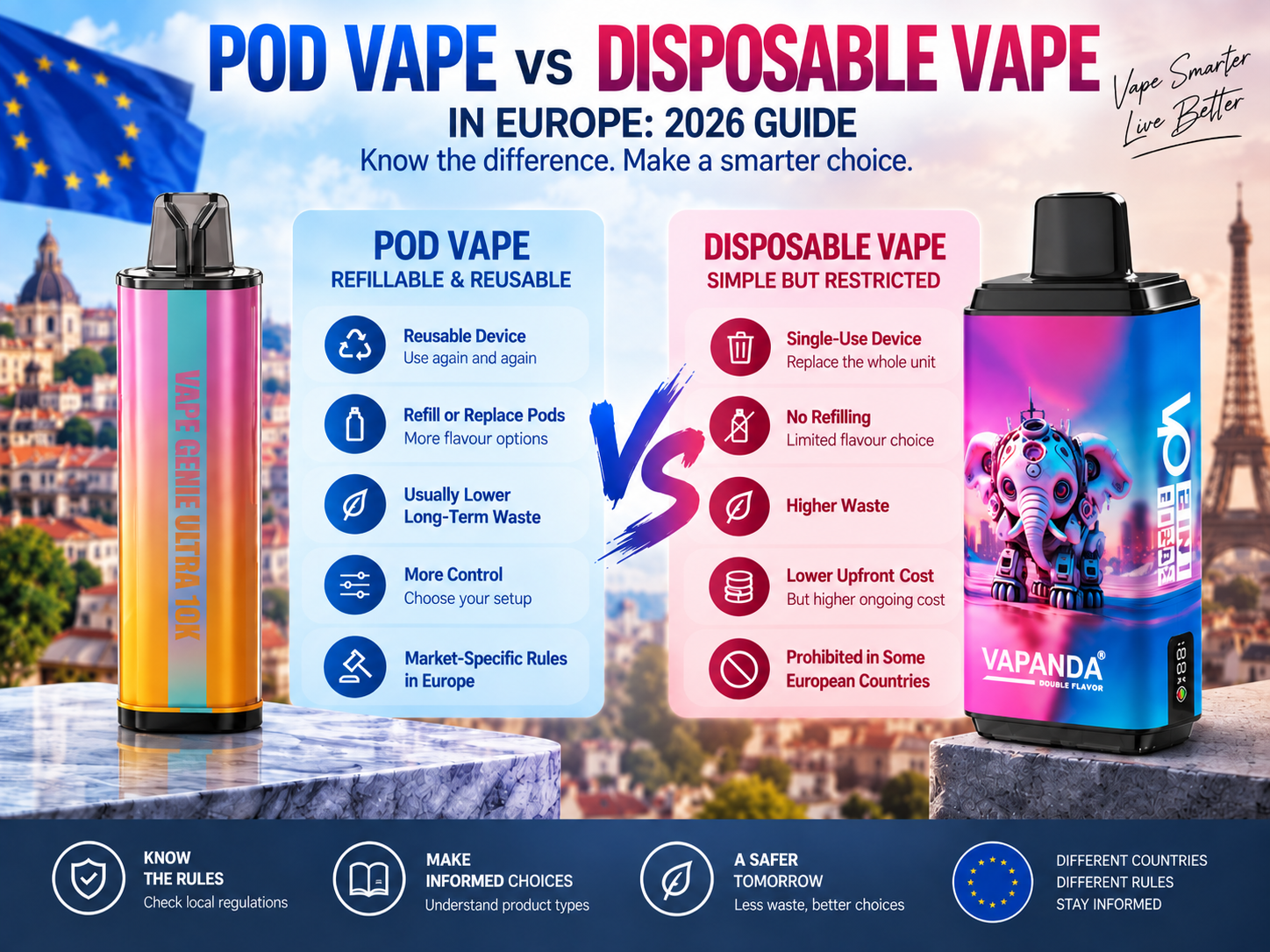
Pod Vape vs Disposable Vape in Europe: 2026 Guide
For regular adult users, a reusable pod vape will usually offer lower long-term hardware waste and more control over consumables. A disposable vape is simpler to start using, but it requires full-device replacement and is now prohibited in several European markets.
The comparison is no longer just about price or convenience. In 2026, buyers and businesses must first establish what type of product they are dealing with and whether that format can legally be sold in the target country.
A rechargeable battery does not automatically make a vape reusable. The decisive question is whether the product is designed to be refilled or used with replaceable consumables rather than discarded as a complete unit.
Pod Vape vs Disposable Vape: Quick Comparison
| Feature | Refillable pod vape | Closed prefilled pod system | Disposable or single-use vape |
|---|---|---|---|
| Main battery device | Reused | Reused | Replaced as a complete unit |
| E-liquid | Added by the user | Supplied in replaceable pods | Integrated into the device |
| Coil | Built into pod or replaceable | Usually built into each pod | Integrated |
| Charging | Normally rechargeable | Normally rechargeable | Rechargeable or non-rechargeable |
| Maintenance | Highest of the three | Low | Minimal |
| Flavour flexibility | Broad, within device compatibility | Limited to compatible pods | Limited to the purchased device |
| Upfront cost | Usually higher | Usually higher | Usually lower per device |
| Ongoing cost structure | E-liquid plus pods/coils | Replacement prefilled pods | Repeated full-device purchase |
| Waste per flavour/liquid cycle | Usually lower | Moderate | Usually highest |
| Legal position in Europe | Market-specific | Market-specific | Prohibited in some countries |
Individual products vary. This table describes the usual architecture, not every model sold under each label.
First, Separate the Three Product Types
1. Refillable pod vape
A refillable pod system uses a rechargeable battery device and a pod that can be filled with compatible e-liquid. The coil may be permanently built into the pod or sold as a replaceable component.
The main device is retained when the liquid or coil reaches the end of its usable life.
2. Closed or prefilled pod system
A closed pod system also reuses the battery device, but the user replaces a sealed, prefilled pod rather than adding bottled e-liquid. It requires less maintenance than an open pod while still separating the reusable hardware from the consumable.
3. Disposable or single-use vape
A disposable vape integrates the battery, heating element and liquid supply into one product intended to be discarded when its usable liquid, coil or battery cycle is finished.
Some single-use products can be recharged through USB Type-C. That allows the battery to be replenished during the product's intended life; it does not make the tank refillable, the coil replaceable or the device genuinely reusable.
Which Costs Less?
A refillable pod system will often cost less over sustained use, but the correct comparison is total cost over time—not the shelf price of one device.
A disposable follows this cycle:
Buy complete device → use → replace complete device
A refillable pod follows this cycle:
Buy reusable device → charge → refill liquid → replace pod or coil when needed
A closed pod system sits between them:
Buy reusable device → charge → replace prefilled pod
A practical cost formula
To compare formats over 30 or 90 days, record:
Total cost = device hardware + pods/coils + e-liquid + replacement devices + applicable taxes
Then compare the cost against the amount of e-liquid actually consumed or the number of days the setup remained usable. Do not rely on advertised puff counts alone, because machine-puff methods and real draw patterns differ.
Why a pod is not automatically cheaper
A pod system can become expensive when proprietary pods are costly, coils are replaced frequently, the device is damaged or the user changes flavours often and discards partially used pods.
Why a disposable is not automatically cheaper
A low initial price can hide the cumulative cost of repeatedly replacing the battery, coil, housing and remaining electronics as one unit.
The direction is still clear for frequent use: retaining the main hardware normally gives a reusable pod system a structural cost advantage. The exact break-even point depends on local prices and consumption.
Convenience and Maintenance
Disposable vape
A disposable is designed to minimise setup. It is normally prefilled, preassembled and draw-activated. There is no separate bottle, pod installation or coil change.
The trade-off is that a problem with one integrated component can end the usable life of the whole device. A depleted liquid supply, failed coil, damaged charging port or battery fault may all require complete replacement.
Closed pod system
A closed system is almost as simple. Users charge the battery and insert a compatible prefilled pod. It reduces liquid handling but creates dependence on the manufacturer's pod range and availability.
Refillable pod system
A refillable pod requires more routine care. Depending on the design, that may include:
- filling the pod without overfilling;
- allowing a new wick time to saturate;
- replacing a worn pod or coil;
- wiping condensation from the contacts;
- keeping the filling seal and airflow path clean;
- using liquid within the manufacturer's recommended range.
For step-by-step care, see the Vape Tank Maintenance Guide.
Which Gives Better Flavour?
There is no category-wide winner.
Flavour depends on the complete heating and airflow system, including:
- coil material and surface area;
- mesh or wire construction;
- power delivery;
- airflow and draw style;
- wick saturation;
- e-liquid formulation;
- pod age and cleanliness;
- the user's draw duration.
Disposable products can be tuned as a sealed system, which may make them consistent while new. Refillable pods offer a wider choice of liquids and, in some products, airflow or power settings. Closed pods trade that flexibility for controlled compatibility.
A useful comparison should therefore look at the actual coil, airflow and liquid—not assume that “pod” or “disposable” guarantees better flavour.
For an explanation of inhalation styles, see MTL vs RDL vs DTL Vaping.
Battery and Charging Differences
Most pod systems are rechargeable because the main device is intended for repeated use. Disposable products may be rechargeable or non-rechargeable, depending on their design.
When comparing batteries, check:
- listed capacity in mAh;
- charging input, not only the connector type;
- whether the device can be used while charging;
- low-battery and protection behaviour;
- whether the liquid or coil is replaceable after charging;
- the manufacturer's charging instructions.
USB Type-C describes a connector. It does not prove fast charging, higher output or reusability.
Environmental and Waste Considerations
All vape formats create waste through batteries, electronics, plastics, pods, coils and packaging. The difference is how often the main hardware is discarded.
A reusable pod retains the battery and circuit across multiple liquid or pod cycles. A single-use product replaces those components with every device. Closed pod systems retain the battery but still generate sealed pod waste.
Used products should follow local collection rules for batteries and electronic waste. They should not be placed in fire, punctured or casually discarded where children or animals can reach them.
Europe in 2026: The Legal Position Comes First
“Europe” is not one uniform vaping market. EU product rules create a common baseline for participating countries, but national governments can impose additional restrictions. The United Kingdom has a separate post-EU regime.
EU baseline under the Tobacco Products Directive
Article 20 of the EU Tobacco Products Directive regulates nicotine-containing electronic cigarettes and refill containers. The framework includes, among other requirements:
- a maximum nicotine concentration of 20 mg/ml;
- a maximum 10 ml volume for nicotine-containing refill containers;
- a maximum 2 ml capacity for cartridges or tanks;
- product notification and ingredient information;
- packaging, leaflet and health-warning requirements;
- restrictions on cross-border advertising and promotion.
Those limits do not mean that every compliant product format is permitted in every member state. National rules may go further, and some rules also extend to nicotine-free products.
United Kingdom
The UK ban on the sale and supply of single-use vapes took effect on 1 June 2025. A product is not made reusable merely by adding a charging port; the UK guidance sets requirements around rechargeability and refillability, with replaceable components where applicable.
France
France prohibited single-use electronic cigarettes commonly known as “puffs” in February 2025. Businesses should assess the product's actual construction rather than relying on labels such as rechargeable or high-puff.
Belgium
Belgium prohibits disposable electronic cigarettes from being placed on its market. Product notification or availability elsewhere in Europe does not override that national prohibition.
Other European countries
Rules on flavours, nicotine-free products, taxation, distance selling, packaging, age verification, retail display and online promotion vary. They can also change faster than an article can be updated.
Before selling, promoting or purchasing a product, verify the current official rules for the specific destination country. This article reflects information checked on 1 September 2026 and is not a substitute for regulatory advice.
Which Format Fits Which Priority?
| Priority | Format that usually fits best | Important qualification |
|---|---|---|
| Lowest routine maintenance | Disposable, where legal | Complete device is repeatedly replaced |
| Reusable main hardware | Refillable or closed pod | Requires compatible consumables |
| Broadest liquid choice | Refillable pod | Liquid must suit the device and local law |
| No bottled-liquid handling | Closed pod | Flavours and strengths depend on pod availability |
| Lower long-term cost for regular use | Often a refillable pod | Local prices and coil life determine the break-even point |
| Simplest travel format | Depends on market and carrier rules | Disposable formats may be prohibited; batteries face transport rules |
| Lowest full-device waste | Usually a reusable pod | Pods, coils and batteries still require proper disposal |
Questions to Ask Before Choosing
- Is the main device intended to be retained and recharged?
- Can the liquid container be refilled or replaced?
- Can the coil be replaced when the design requires it?
- What will compatible pods, coils or liquid cost over three months?
- How much maintenance is realistic for the user?
- Are the nicotine strength, tank size, packaging and notification compliant in the destination market?
- Is the product format itself prohibited by national law?
- How will used batteries and components be collected or recycled?
These questions are more reliable than choosing by appearance, puff count or charging port alone.
Frequently Asked Questions
Is a pod vape the same as a disposable vape?
No. A pod vape normally retains the battery device and replaces or refills the consumable. A disposable is designed around replacing the complete integrated unit.
Is a rechargeable disposable the same as a pod system?
No. Rechargeability only describes the battery. A pod system has a separately replaceable or refillable consumable and is designed for continued use of the main device.
Are pod vapes cheaper than disposables?
Often over sustained use, but not always. Compare the device, liquid, pods, coils, replacement rate and taxes over the same period.
Which format has better flavour?
Neither category always wins. Coil construction, liquid, airflow, power and wick condition have a greater direct effect than the label on the device.
Are all disposable vapes banned in Europe?
No single Europe-wide statement covers every country. The UK, France and Belgium prohibit single-use or disposable vapes under their respective rules, while other markets have different restrictions. Always check the target country.
Are pod vapes legal in the EU?
Pod systems can be legal when the product and sale comply with EU and national requirements. Tank capacity, nicotine concentration, notification, packaging, advertising and country-specific rules still apply.
Can I travel with a pod or disposable vape?
Airline, airport, battery and destination-country rules apply. Vapes are generally subject to restrictions on checked baggage and use, but travellers must verify the current carrier and government requirements before departure.
Final Verdict
A disposable vape prioritises immediate simplicity but replaces the whole product. A closed pod reuses the battery while keeping consumables simple. A refillable pod requires more maintenance but provides the greatest control over liquid and usually the strongest long-term cost structure for regular adult use.
In Europe in 2026, the decision cannot be made on product features alone. Check whether the format is legal in the destination market first, then compare total cost, maintenance, compatibility and waste.
Official Sources
- European Commission — Electronic Cigarettes
- EUR-Lex — Consolidated Tobacco Products Directive
- UK Government — Single-Use Vapes Ban
- Legifrance — Law No. 2025-175 Prohibiting Single-Use Vaping Devices
- Belgian FPS Public Health — Tobacco: What the Law Says
This article is intended for adults of legal vaping age and provides general information, not medical, legal or regulatory advice. Laws vary by country and may change. Verify current official requirements before buying, selling, importing, advertising or using vaping products.