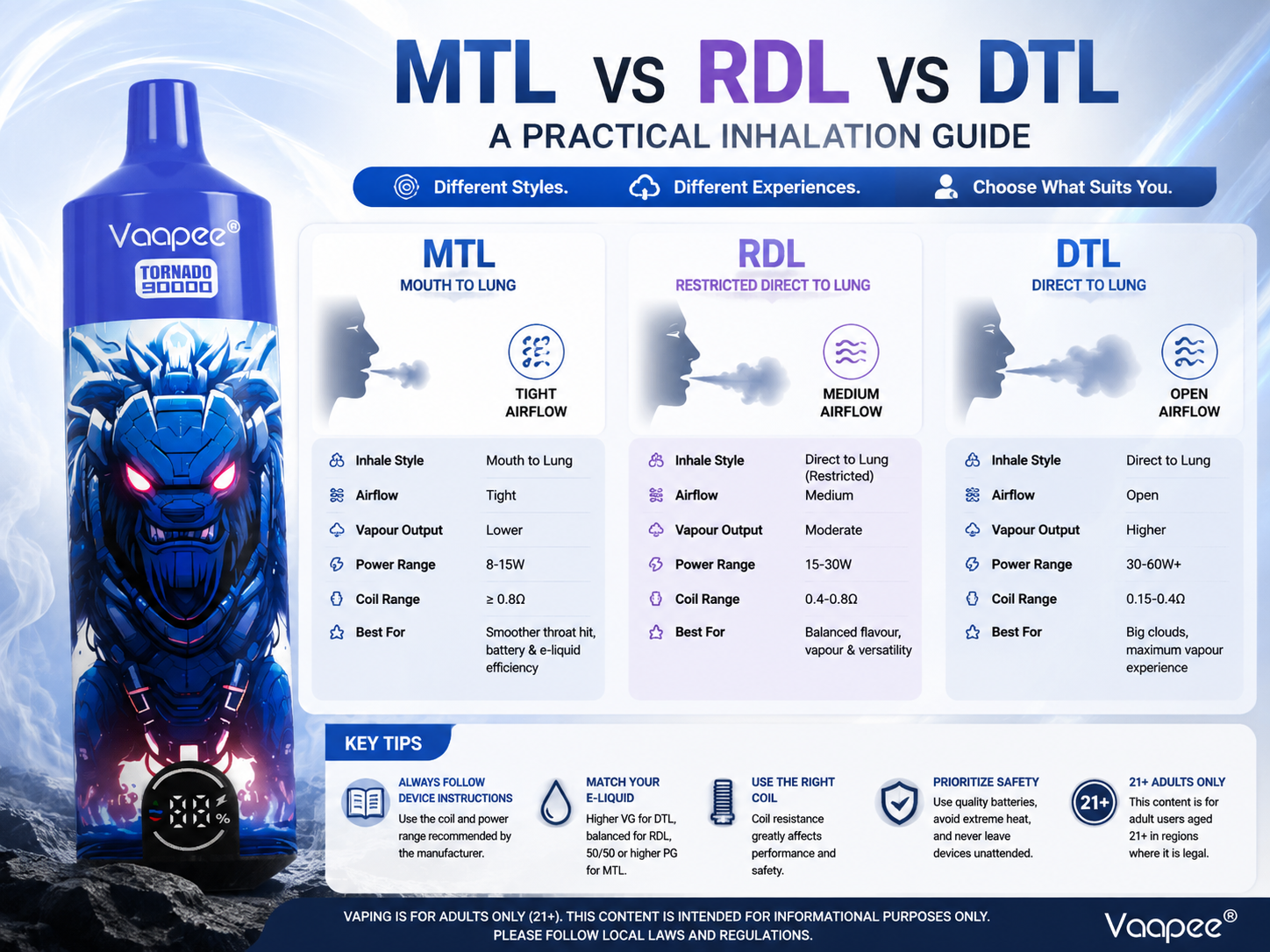
MTL vs DTL vs RDL: A Practical Guide to Vaping Inhalation Styles
MTL, RDL and DTL describe how an adult user draws aerosol from a vaping device. They are useful shorthand, but they are not rigid engineering standards. A device's actual behaviour depends on its coil, airflow, power setting, e-liquid formulation and the manufacturer's operating instructions.
The most important rule is simple:
Match the coil, power range and e-liquid to the device instructions. Do not choose settings from a generic chart when the manufacturer specifies something different.
Quick comparison
| Style | Inhalation pattern | Airflow | Typical vapour output | Typical hardware approach |
|---|---|---|---|---|
| MTL | Aerosol is drawn into the mouth before inhalation | Tight | Lower | Lower-power pods or tanks with restricted airflow |
| RDL | Direct inhale with noticeable restriction | Medium | Moderate | Adjustable pods or tanks with medium airflow |
| DTL | Direct inhale through open airflow | Open | Higher | Higher-airflow tanks or compatible high-output devices |
These categories overlap. A 0.6Ω coil, for example, may be used differently across devices. Resistance alone does not determine the correct inhalation style or power setting.
What is MTL vaping?
MTL stands for mouth-to-lung. The user draws aerosol into the mouth first and then inhales. The draw is usually tighter and the aerosol volume is usually lower than with RDL or DTL.
Common MTL characteristics
- Restricted airflow
- Lower power demand than most DTL setups
- Smaller aerosol volume per draw
- Common use in compact pod systems and MTL tanks
- Frequent compatibility with balanced or moderately thin e-liquids, depending on the coil design
Many MTL coils are around 0.8Ω or above, but this is only a common range. Some devices use lower-resistance coils while still producing a restricted draw. Always use the power range printed on the coil or stated in the manual.
Potential advantages
- Lower e-liquid and battery consumption than many high-output setups
- Smaller and more portable hardware options
- A controlled draw that some adult users prefer
Limitations
- Lower vapour output
- Less airflow adjustment on some compact devices
- Thick, high-VG liquids may wick poorly in small coils unless the manufacturer explicitly supports them
What is RDL vaping?
RDL stands for restricted direct-to-lung. It uses a direct inhale but retains more resistance than a fully open DTL setup.
RDL is best understood as a middle range rather than a fixed specification. Devices marketed for RDL commonly combine adjustable airflow, moderate power and coils that sit between typical MTL and DTL designs.
Common RDL characteristics
- Medium airflow resistance
- Moderate vapour output
- More power and e-liquid use than many MTL setups
- Less power and aerosol volume than many open-airflow DTL setups
- Compatibility that varies significantly by coil and pod design
Potential advantages
- A balance between airflow, vapour output and portability
- More flexibility on devices with genuinely compatible coil and airflow options
- Lower consumption than many high-output DTL configurations
Limitations
- Airflow adjustment alone may not be enough to convert an MTL setup into an RDL setup
- The wrong coil or power setting can cause weak performance, flooding or dry hits
- Medium-output hardware still requires correct e-liquid viscosity and nicotine strength
What is DTL vaping?
DTL stands for direct-to-lung. The user inhales directly through an open airflow path. DTL devices generally move more air and generate more aerosol per draw than MTL or RDL devices.
Common DTL characteristics
- Open airflow
- Higher power demand
- Higher e-liquid and battery consumption
- Larger aerosol volume
- Common use of lower-resistance coils and higher-VG e-liquids
Lower-resistance coils do not automatically make a device safe or suitable for DTL use. The tank, battery, chipset, airflow and coil must be designed to work together.
Potential advantages
- Higher vapour output for adults who already choose that style
- Broad airflow control on many compatible tanks
- Good compatibility with thicker liquids when the coil is designed for them
Limitations
- Faster battery and e-liquid consumption
- Larger aerosol exposure per draw
- Greater risk of excessive nicotine exposure if a high-strength liquid is paired with high aerosol output
- More heat and more demanding battery requirements
If use causes nausea, dizziness, headache, throat discomfort or other unexpected symptoms, stop using the product. Persistent or severe symptoms require advice from a qualified healthcare professional.
Coil resistance and wattage: why generic numbers are not enough
Ohm and wattage ranges are helpful for comparison, but they should not be treated as universal rules.
| Style | Common resistance tendency | Common power tendency |
|---|---|---|
| MTL | Often higher resistance | Usually lower power |
| RDL | Often mid-range resistance | Usually moderate power |
| DTL | Often lower resistance | Usually higher power |
Two coils with the same resistance can have different materials, surface areas, airflow structures and recommended wattage ranges. Use only compatible coils and never exceed the manufacturer's rated range.
Matching VG/PG ratio to the device
VG and PG affect viscosity, wicking and aerosol characteristics.
- Balanced formulations, such as 50/50 VG/PG, are commonly used in many compact pods and MTL systems.
- Higher-VG formulations are thicker and are commonly used in compatible higher-flow coils.
- Higher-PG formulations are thinner and may flood some coils if the system is not designed for them.
These are tendencies, not guarantees. Follow the device and e-liquid manufacturer's compatibility information.
Nicotine strength needs a market and device context
There is no single nicotine strength that is correct for every MTL, RDL or DTL setup. The amount delivered depends on the liquid concentration, aerosol output, draw duration, device power and use pattern.
Higher-output devices are generally paired with lower nicotine concentrations because they can produce more aerosol per draw. Never use an e-liquid strength that is unlawful in the destination market or incompatible with the device.
For example, nicotine-containing e-liquids placed on the EU market are subject to a maximum nicotine concentration of 20mg/ml under Directive 2014/40/EU. Other jurisdictions use different rules.
How to choose among MTL, RDL and DTL
Ask five practical questions:
- What airflow does the device support? Do not force an inhalation style the device was not designed for.
- What coil is installed? Check its resistance and printed power range.
- What liquid does the manufacturer permit? Pay attention to viscosity and nicotine concentration.
- How much aerosol does the setup produce? More aerosol can mean more nicotine exposure and faster liquid consumption.
- What does local law allow? Age limits, product requirements and public-use restrictions vary by jurisdiction.
Common setup problems
Burnt taste
Possible causes include insufficient liquid reaching the wick, excessive power, an old coil or repeated draws without enough recovery time. Stop using the device if the burnt taste persists and replace the coil or pod where applicable.
Leakage or gurgling
Possible causes include a damaged seal, incorrect coil installation, overfilling, condensation, unsuitable liquid viscosity or pressure changes. Inhalation style alone is rarely the only cause.
Weak flavour or low vapour
Check the battery level, airflow, coil age, electrical contacts, liquid level and manufacturer-recommended settings before increasing power.
For a fuller maintenance process, see our vape tank maintenance guide.
Frequently asked questions
Can the same pod switch between MTL and RDL?
Only if the manufacturer supports both configurations. Adjustable airflow may change draw resistance, but some devices also require a different coil or power setting.
Can nicotine salts be used in a DTL device?
Do not assume that all nicotine-salt liquids are suitable. Pairing a high-strength liquid with a high-output setup may result in excessive nicotine exposure. Follow the device and liquid instructions and the legal concentration limit in the destination market.
Is 50/50 VG/PG always best for MTL?
No. It is common, but coil design and manufacturer guidance take priority.
Is one style safer than another?
This guide does not rank inhalation styles by health risk. Vaping is not risk-free, nicotine is addictive, and aerosol exposure depends on the product and how it is used. Adults who do not use tobacco or nicotine products should not start.
Final thoughts
MTL, RDL and DTL are useful comparison labels, not universal technical specifications. A suitable setup is one in which the coil, airflow, power and liquid are compatible with each other and used within the manufacturer's instructions.
Adult-use and safety notice
This article is intended for adults of legal smoking or vaping age and provides general device information, not medical advice. Nicotine is addictive. Keep vaping products and e-liquids away from children and pets. Follow local laws, manufacturer instructions and product-specific warnings.