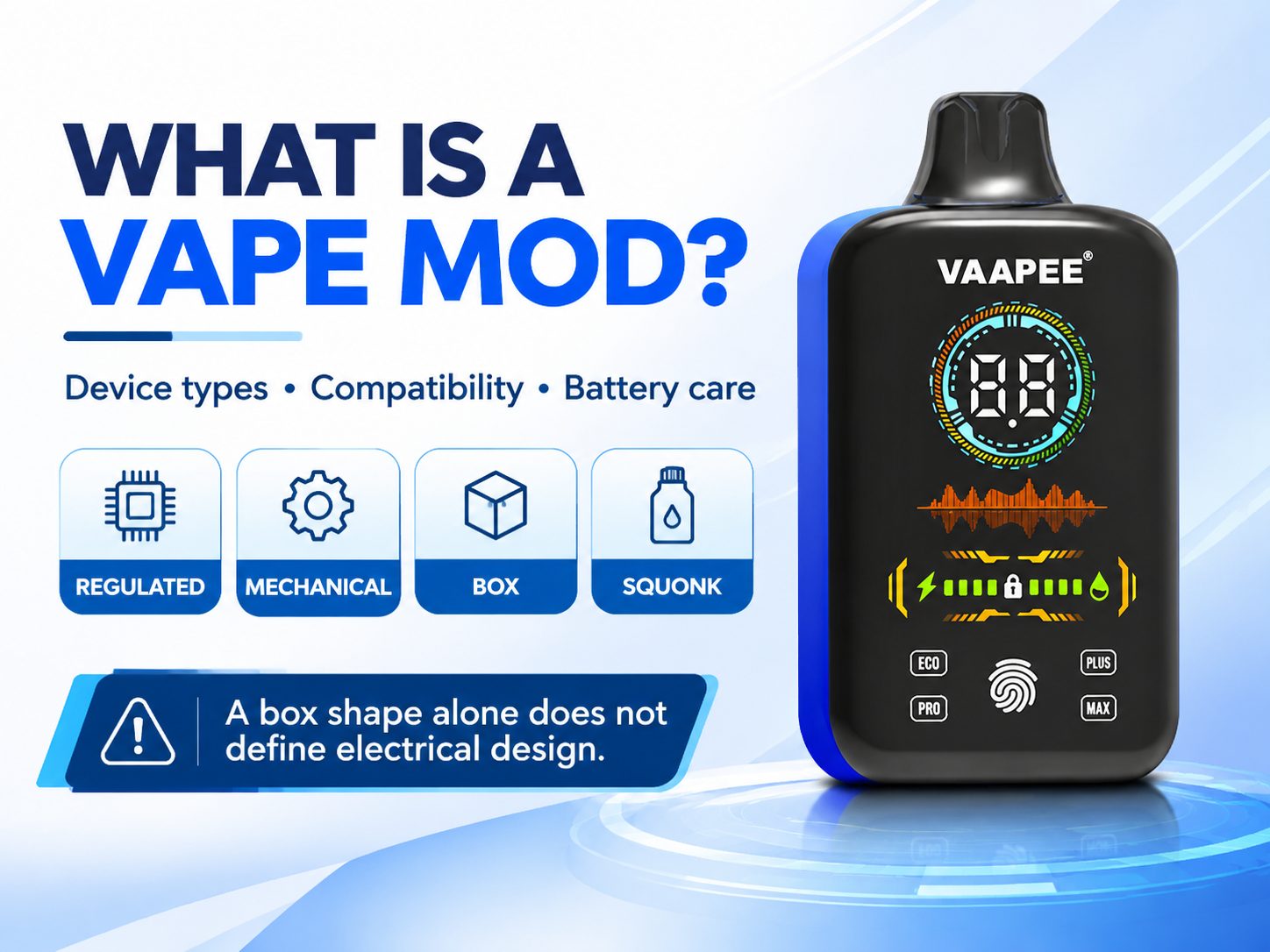
What Is a Vape Mod?
A vape mod is the power unit that supplies electricity to a compatible atomiser or tank. Depending on the model, it may offer adjustable output, a display and an integrated battery or removable cells.
The word “mod” does not identify one electrical design. A box shape, a rechargeable battery and a large display do not establish which protections a device has or which parts can be attached.
How the main descriptions differ
| Description | What it describes | What still needs checking |
|---|---|---|
| Regulated mod | Electronic management of output | Actual protection features and operating limits |
| Mechanical mod | A design typically without electronic output regulation | Battery, circuit and atomiser suitability |
| Box mod | The shape of the housing | Whether it is regulated or unregulated |
| Squonk mod | A reservoir that feeds a compatible bottom-feeding atomiser | Both the feeding connection and electrical design |
These categories overlap. A squonk device can be regulated, while a box-shaped device is not necessarily regulated.
Regulated mods
A regulated device uses control electronics to manage output. Depending on its design, it may provide adjustable wattage, temperature-control modes, current limits or fault detection.
Check the specific manual rather than assuming every regulated mod has identical protections. Electronic safeguards do not make a damaged battery, unsuitable coil or wet connector acceptable.
Mechanical mods
Mechanical devices generally lack the output control and many protections found in regulated equipment. An unsuitable configuration can draw excessive current and cause overheating or battery failure.
They are unsuitable for inexperienced users. This overview does not provide instructions for building coils, selecting an unprotected circuit or modifying a mechanical or hybrid connection. A successful physical fit is insufficient evidence of suitability.
Box and squonk designs
“Box” describes housing form. “Squonk” describes a liquid-delivery arrangement using an internal bottle and a compatible bottom-feeding atomiser. Neither word identifies the battery's discharge capability or the presence of a particular protection circuit.
Do not connect an ordinary tank to a bottom-feeding system on the assumption that a matching thread makes it suitable. Follow the complete device and atomiser instructions.
Mods, pens and pod systems
Mods often allow more configuration, while many pens and pod devices use integrated or proprietary assemblies. There are exceptions: some pods allow adjustable output, and some mods offer limited controls.
Compare the actual functions rather than treating these names as a quality ranking. Useful specifications include the supported atomisers, coil range, operating modes, battery requirements, charging arrangement and serviceable components.
Power and coil compatibility
Wattage describes electrical power. Coil resistance is measured in ohms. Both matter, but resistance alone does not establish the appropriate power setting.
Use the exact coil's supported wattage range and mode. Temperature-control operation requires a suitable coil material and device configuration. Do not select a material profile by guessing from appearance or resistance.
A regulated mod's battery-side current is also not determined by coil resistance alone: conversion circuitry and operating power matter. Do not treat a simple coil calculation as a complete battery-selection test.
Before attaching a tank, check:
- The exact tank and approved coil family.
- Connector condition and physical clearance.
- Supported resistance and output limits.
- The coil's intended operating mode.
- The battery and charging specifications for the mod.
Do not force a threaded connection, pry a contact pin or bypass insulation to make parts work together.
Integrated and removable batteries
An integrated battery should be charged and serviced only as specified. Do not open a sealed unit to replace or recharge a cell directly.
For removable cells, physical dimensions alone do not establish suitability. Follow the device manufacturer's cell specification, including any requirements for multi-cell sets. Do not mix incompatible types, old and new cells or different charge states. Damaged wraps, insulators or cell housings require stopping use and following approved replacement guidance.
Carry spare cells in a protective case that prevents contact with metal objects. Loose cells should not be carried alongside keys or coins.
The FDA's battery guidance recommends the specified batteries and equipment, protection from extreme temperatures and observing charging on a clear surface away from combustibles. Charging through the mod or in an external charger must follow the exact model's instructions; neither arrangement is universally appropriate.
Responding to faults
| Symptom | Response |
|---|---|
| No Atomiser or Check Atomizer | Switch off and follow the model's checks for approved accessible components |
| Short-circuit warning | Stop activation; do not bypass the warning |
| Large unexplained resistance changes | Check the permitted installation points and obtain support if unresolved |
| Excessive heat, swelling or liquid inside electronics | Stop use and charging; obtain product-specific assessment |
| Charging will not start | Check the specified equipment and indicator instructions |
Do not repeatedly fire a suspect device to see whether the fault disappears. If it smokes or burns, keep clear and contact emergency services rather than handling it.
The charging troubleshooting guide explains why a blank display, depleted reservoir and battery fault need different checks.
UK rules checked on 22 October 2026
The following is a dated summary for UK readers, rather than confirmation that a particular mod or kit can be sold.
Single-use and reusable products
The UK single-use vape ban has applied to business sale and supply since 1 June 2025, including products without nicotine. Charging capability alone does not establish reuse. Official guidance requires a rechargeable battery, a refillable system and a replaceable coil where present. Replacement pods can satisfy the relevant refill and coil requirements when they meet the guidance; refills must be available separately.
Nicotine-product requirements
MHRA guidance describes limits including 20 mg/ml nicotine concentration, 10 ml for a nicotine-containing refill container and 2 ml for e-cigarette tanks within the relevant consumer-product rules. Notification, packaging and safety requirements also apply.
These limits should not be applied indiscriminately to an isolated battery power unit, nor treated as proof of compliance for an assembled kit.
Changes scheduled for 29 October 2026
At this review date, government guidance on selling vaping and nicotine products states that expanded age-of-sale and proxy-purchasing rules, together with restrictions on promotional free distribution and substantial promotional discounts, take effect on 29 October 2026. The stated sales age is 18 and over. Existing age restrictions already apply to relevant products; this is not the first introduction of all age controls. Check the rules in force on the actual sale date and in the relevant UK nation.
Frequently asked questions
Are box mods always regulated?
No. Shape and electrical design are separate descriptions. Check the device specification.
Does higher wattage mean better performance?
Not by itself. The output must suit the coil, liquid supply, battery and device limits.
Do all mods have removable batteries?
No. Some contain integrated rechargeable batteries; others accept specified removable cells.
Can every tank with a 510 fitting be used on a mod?
No. The electrical limits, operating mode, coil compatibility and clearance must also suit the exact combination.
Does rechargeable mean legally reusable in the UK?
No. Charging is only one element of the applicable definition. The refill and replacement requirements must also be met.
Adult use notice
This guide is for adults of legal vaping age. Nicotine is addictive, and vaping is not risk-free. Adults who do not use tobacco or nicotine products should not start. Keep devices and liquids away from children and pets and follow product instructions and local laws.