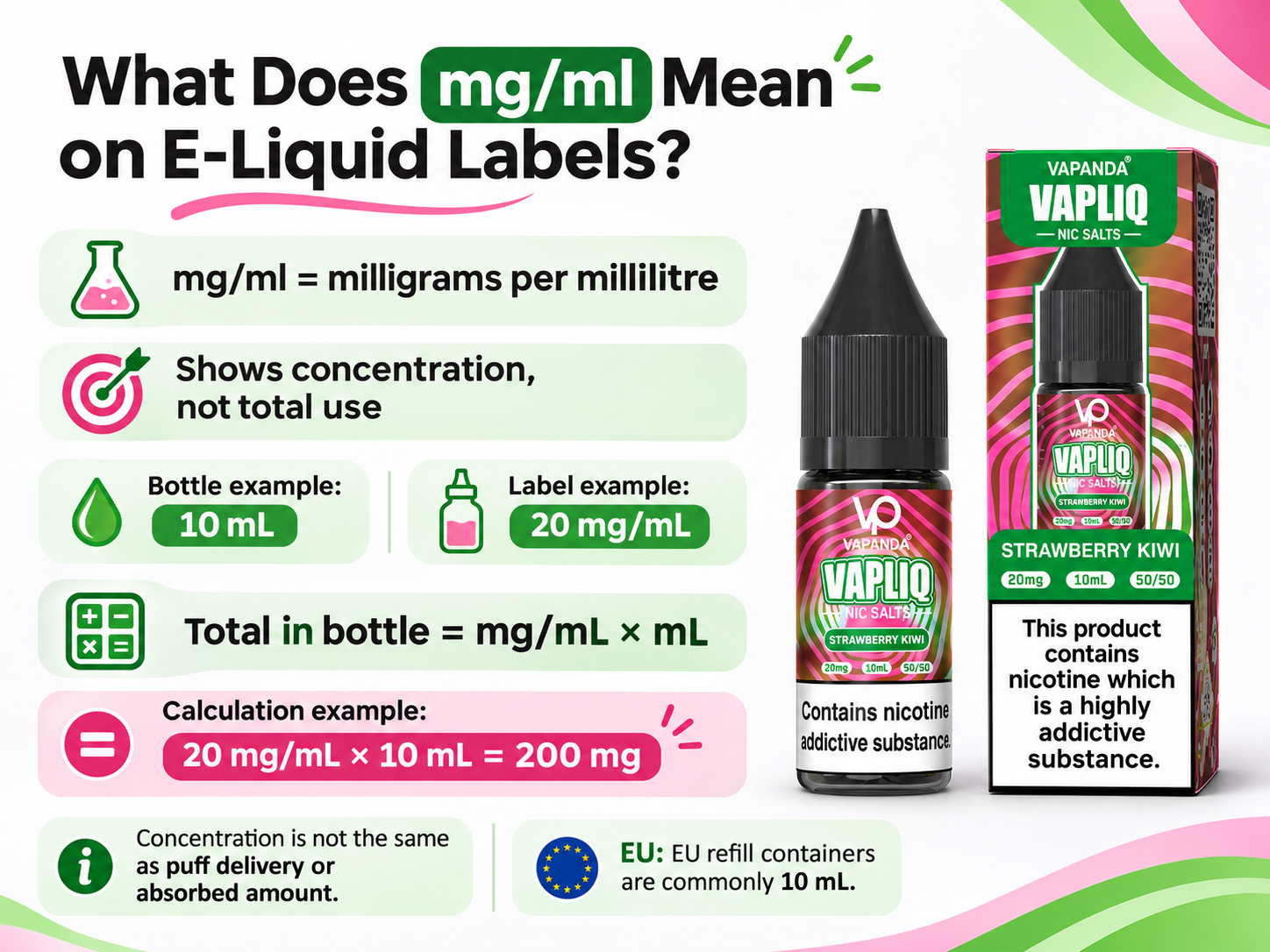
What Does mg/ml Mean on an E-Liquid Bottle?
On an e-liquid label, mg/ml means milligrams of nicotine per millilitre of liquid. It describes concentration. It does not state the total nicotine in the bottle, the amount delivered in one puff or the amount absorbed by a person.
A percentage can describe concentration too, but its basis must be known before converting it. The familiar rule that 2% equals 20 mg/ml applies to mass-per-volume percentage, not automatically to every label displaying a percent sign.
Understanding the units
mgis a milligram, a unit of mass.mlormLis a millilitre, a unit of volume.mg/mlis mass per unit volume.
For example, a stated concentration of 6 mg/ml means 6 mg of nicotine in each millilitre of that liquid. This is an example of mass concentration as defined by IUPAC.
| Labelled concentration | Meaning |
|---|---|
| 3 mg/ml | 3 mg of nicotine per ml of liquid |
| 6 mg/ml | 6 mg of nicotine per ml of liquid |
| 10 mg/ml | 10 mg of nicotine per ml of liquid |
| 20 mg/ml | 20 mg of nicotine per ml of liquid |
These are unit-reading examples, not recommendations for a particular user or device.
Concentration and total bottle contents
Bottle volume and nicotine concentration are separate specifications. To calculate the nicotine mass represented by a label, multiply them:
Labelled nicotine mass (mg) = concentration (mg/ml) * liquid volume (ml)
For a 10 ml bottle labelled 6 mg/ml:
6 mg/ml * 10 ml = 60 mg
| Concentration | Liquid volume | Calculated nicotine mass |
|---|---|---|
| 3 mg/ml | 10 ml | 30 mg |
| 6 mg/ml | 10 ml | 60 mg |
| 10 mg/ml | 10 ml | 100 mg |
| 20 mg/ml | 10 ml | 200 mg |
The result is the stated content of the liquid in the bottle. It is not an absorbed dose or a safe exposure limit. The calculation also assumes that the concentration and volume on the label are accurate; it does not independently measure either quantity.
Converting mass-per-volume percentages
A mass-per-volume percentage, often written w/v or m/v, expresses grams of a substance per 100 ml of the mixture.
1% w/v = 1 g per 100 ml
       = 1000 mg per 100 ml
       = 10 mg/ml
When this is the declared basis:
mg/ml = percentage number * 10
percentage number = mg/ml / 10
| Percentage, explicitly w/v | Equivalent concentration |
|---|---|
| 0.3% | 3 mg/ml |
| 0.6% | 6 mg/ml |
| 1.0% | 10 mg/ml |
| 2.0% | 20 mg/ml |
In the formula, the percentage number is 2 for a label saying 2%, rather than the fraction 0.02.
Why mass-per-mass percentages need another step
A mass-per-mass percentage, written w/w or m/m, describes a mass fraction. It refers to nicotine mass divided by total liquid mass, rather than volume. See the IUPAC definition of mass fraction.
To convert it to mg/ml, the density of the mixture is needed:
mg/ml = percentage number (w/w) * 10 * density (g/ml)
For a purely illustrative mixture labelled 1% w/w with density 1.20 g/ml:
1 * 10 * 1.20 = 12 mg/ml
The example shows why directly applying the w/v shortcut can be wrong. It is not a measured specification for an e-liquid product. Do not assume a liquid's density, or guess that the difference is always small.
If a label gives only a percentage without its basis, ask the supplier for the nicotine concentration in mg/ml and the method used to express the percentage. If two figures disagree, obtain clarification rather than selecting the more convenient number.
A nicotine-salt label still needs a clear basis
The presence of nicotine salts does not change the meanings of mg and ml. However, a specification should make clear whether the stated figure refers to nicotine content or to the mass of a salt ingredient.
Do not assume that a percentage of a named salt is automatically the same as nicotine concentration. Use the manufacturer's documented nicotine specification when interpreting the label.
What 0 mg/ml means
A 0 mg/ml label declares zero nicotine concentration. Saying only that a product has “no added nicotine” describes formulation intent and is not the same as a measured zero concentration.
Neither wording is an independent laboratory result or a guarantee that the product is risk-free. If absence of nicotine is essential, ask for appropriate product information rather than relying on a flavour name or a marketing phrase.
Concentration is not personal exposure
Nicotine delivery and absorption depend on the device, liquid, output setting and use. A bottle calculation cannot establish the amount reaching a person during a session.
Do not convert bottle contents into a fixed number of cigarettes or a recommended daily intake. Likewise, perceived throat sensation is not a concentration test: formulation and device operation can change the sensation.
EU nicotine-liquid limits
For consumer products within Article 20 of Directive 2014/40/EU, nicotine-containing liquid is limited to 20 mg/ml, and a dedicated refill container to 10 ml. These are product limits, not recommended doses or a complete legal-status check.
The European Commission's overview also describes packaging, notification and other requirements. National restrictions must be checked separately. “Europe” should not be used as a substitute for the EU when stating these limits.
A bottle displaying 10 ml and 20 mg/ml does not, by those numbers alone, prove compliance. Zero-nicotine products can also be subject to other product, chemical, packaging and national rules; 0 mg/ml does not mean unregulated.
Reading the rest of the label
Confirm the exact product, nicotine specification, liquid volume, ingredients, warnings, batch information and responsible supplier. Keep the original packaging if a label needs clarification.
The guide to vape labels explains why a batch code, QR code and puff count answer different questions. A nicotine concentration figure cannot replace those other checks.
Frequently asked questions
Is 20 mg/ml the same as 20 mg?
No. The first is concentration; the second is mass. A 10 ml bottle labelled 20 mg/ml represents 200 mg of nicotine in its liquid.
Does 2% always mean 20 mg/ml?
It does when 2% is explicitly mass per volume. A mass-per-mass percentage requires density for conversion.
Does a larger bottle mean a stronger concentration?
No. Volume and concentration are independent. Read both before calculating the stated nicotine mass.
Is mg/ml the same as device wattage?
No. mg/ml describes liquid concentration; watts describe electrical power.
Does a 0 mg/ml label mean the product is harmless?
No. It is a nicotine-content declaration, not a general health or safety guarantee.
Adult use notice
This information is for adults of legal vaping age. Nicotine is addictive, and vaping is not risk-free. Adults who do not use tobacco or nicotine products should not start. Keep liquids away from children and pets, and follow product instructions and local laws.