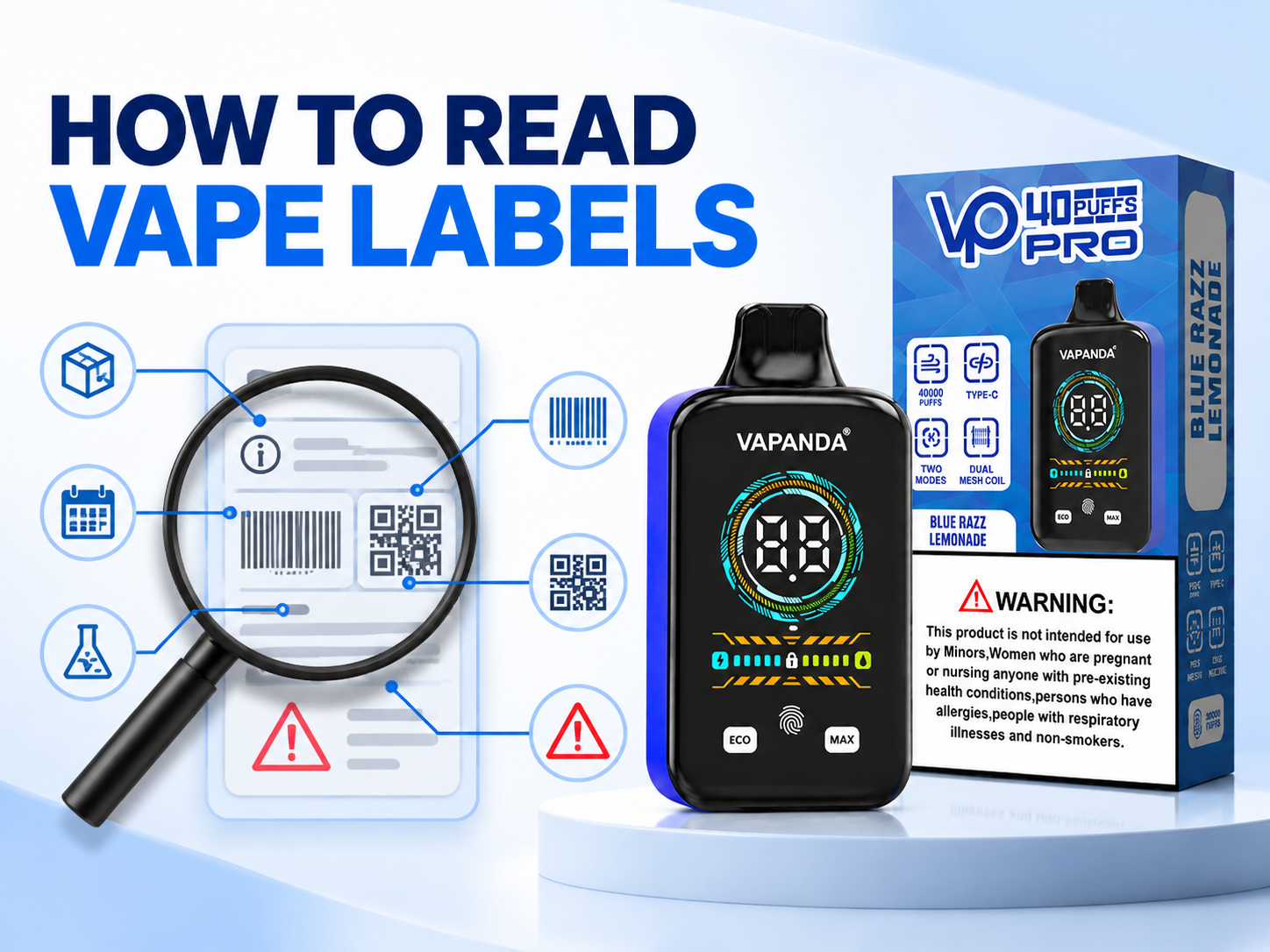
How to Read Disposable Vape Labels
A batch code identifies a production batch, a date marking describes a particular date, and a puff count states a performance claim. They answer different questions. None of them, by itself, proves that a vape is genuine, safe or permitted for sale in a particular country.
This guide explains how adults can read the information supplied with a product, including products described as disposable. It does not establish that single-use devices are available legally in the reader's market.
Start with product identity and contents
Match the brand and exact model on the device to its box and accompanying instructions. A similar name or identical-looking casing does not establish that two versions have the same liquid, battery or operating requirements.
| Marking | What it describes | What it does not establish |
|---|---|---|
| Brand and model | The stated product identity or version | That the physical item is genuine |
| Nicotine concentration, such as mg/ml | The stated nicotine mass per unit of liquid | Nicotine absorbed by a person |
| Liquid volume, in ml | The stated amount of liquid | Battery runtime or guaranteed puff count |
| Batch or lot code | A production group in the supplier's records | A universally readable manufacturing date |
| Serial number | An individual identifier, if the supplier uses one | Authenticity without checking the supplier's records |
| Puff count | A manufacturer's stated performance figure | The result every user will obtain |
For products within its scope, Article 20 of the EU Tobacco Products Directive sets packaging and information requirements. These include ingredients, nicotine details, batch identification, warnings and accompanying instructions. The European Commission's overview explains the framework. Check the applicable national rules as well as the exact product category.
Reading a batch code
A batch or lot number helps the manufacturer or responsible supplier trace a group of products. It may be needed for a quality enquiry, recall or report of a fault.
There is no universal decoding rule. A series of digits might represent a production run, factory line, internal reference or date-related code. Ask the supplier to explain the coding system rather than assuming a familiar-looking number is a calendar date.
The following examples are fictional:
| Example | Reasonable interpretation |
|---|---|
MODEL: SAMPLE-01 |
A stated model identifier |
LOT: A7K9 |
A batch identifier whose meaning needs supplier records |
SN: 00012345 |
A possible individual identifier |
MFG: 2026-09-15 |
An explicitly labelled manufacturing date |
EXP: 2027-09-15 |
An expiry marking to interpret with the product instructions |
If a date is written as 03/04/2026, check the intended date format. Do not assume whether the first number is the day or month.
Does a batch number prove authenticity?
No. A copied identifier can appear on more than one item. Verification requires a reliable connection between the physical product, its identifiers and the supplier's records.
Record the model and code exactly, retain the packaging and proof of purchase, and contact the manufacturer or responsible supplier through an independently verified channel. Ask about the specific batch rather than only whether a brand name exists.
What about QR codes and barcodes?
A QR code is a route to a webpage or other data. A convincing webpage is not proof of the physical product's origin.
Inspect the destination address before entering information. Confirm that it belongs to the manufacturer or a verification service the manufacturer names. Compare the model and batch information with the packaging. Do not install an unfamiliar app or provide payment details just because a label tells you to do so.
Manufacturing dates and expiry dates
A manufacturing date tells you when a product was made. It does not, on its own, establish its intended shelf life. A batch code should not be treated as an expiry date unless the manufacturer confirms that meaning.
Follow any explicit expiry, use-by or best-before marking and the associated storage instructions. These terms should not be assumed to have identical meanings across manufacturers or product categories. Ask the supplier if the marking is unclear or missing; do not invent a lifetime by adding a generic number of months to the manufacturing date.
Storage and physical condition still matter. A device can be unsuitable before a printed date if it is damaged, leaking or showing a battery fault. Conversely, a readable date is not a condition test. Do not activate or charge a suspect device to find out whether it still works.
For user-serviceable hardware, the tank maintenance guide covers routine checks. Those procedures do not authorise opening or servicing a sealed disposable.
What an advertised puff count means
A puff-count figure is a manufacturer's claim made under stated or unstated conditions. It is not a universal unit of device lifetime.
Ask which puff duration, operating mode and end point were used in the test, and whether the figure covers one charge or the whole product life. A longer activation can use a different amount of liquid and energy from a shorter one. Different settings can also change the result.
Useful questions include:
- Is there a documented test method for this exact model?
- Is the advertised figure an estimate, a maximum or a guaranteed result?
- Which power or output mode was used?
- What counted as the end of usable operation?
A high number alone does not prove more liquid, a larger battery, better quality or lower health risk. Do not convert puffs into nicotine dose or cigarette equivalents from packaging alone.
Packaging and legal market status
A complete-looking label is only part of a product assessment. A notification identifier or compliance statement should not be presented as blanket authorisation for every country or product version.
The Commission publishes national measures notified under Article 24(3). The need to check national restrictions remains separate from reading the information on the box. Europe, the European Union and the United Kingdom are not interchangeable regulatory areas.
Check the exact model and intended country, the relevant authority's current guidance and the responsible supplier's supporting records. Do not infer market eligibility from a QR code, country flag or the appearance of another product's label.
If information is unclear
Photograph the relevant markings and ask for the meaning of the code, the liquid specification, the applicable instructions and the responsible business's contact details. Avoid publishing a full serial number or receipt containing personal information when making a public enquiry.
If the supplier cannot resolve a missing warning, unexplained label or suspected defect, contact the appropriate local consumer-protection or product authority. Keep the product out of reach of children and pets while resolving the issue.
Frequently asked questions
Is a lot number the same as a serial number?
Usually not. A lot number groups a production batch; a serial number may identify one unit. The manufacturer's system determines the meaning.
Can I find the manufacturing date inside the batch code?
Only if the manufacturer confirms its coding rules. A date-like sequence is not enough.
Does scanning an official-looking QR code prove the device is genuine?
No. Check the destination independently and confirm the identifiers with the responsible supplier.
Does the puff rating tell me how long the battery lasts?
Not necessarily. It may refer to the total life of a rechargeable product rather than one charge. Check the stated test basis.
Does compliant-looking packaging prove legal sale throughout Europe?
No. Product information, traceability and national market requirements are separate checks.
Adult use notice
This guide is for adults of legal vaping age. Nicotine is addictive, and vaping is not risk-free. Follow product instructions and local laws, and keep devices and liquids away from children and pets.