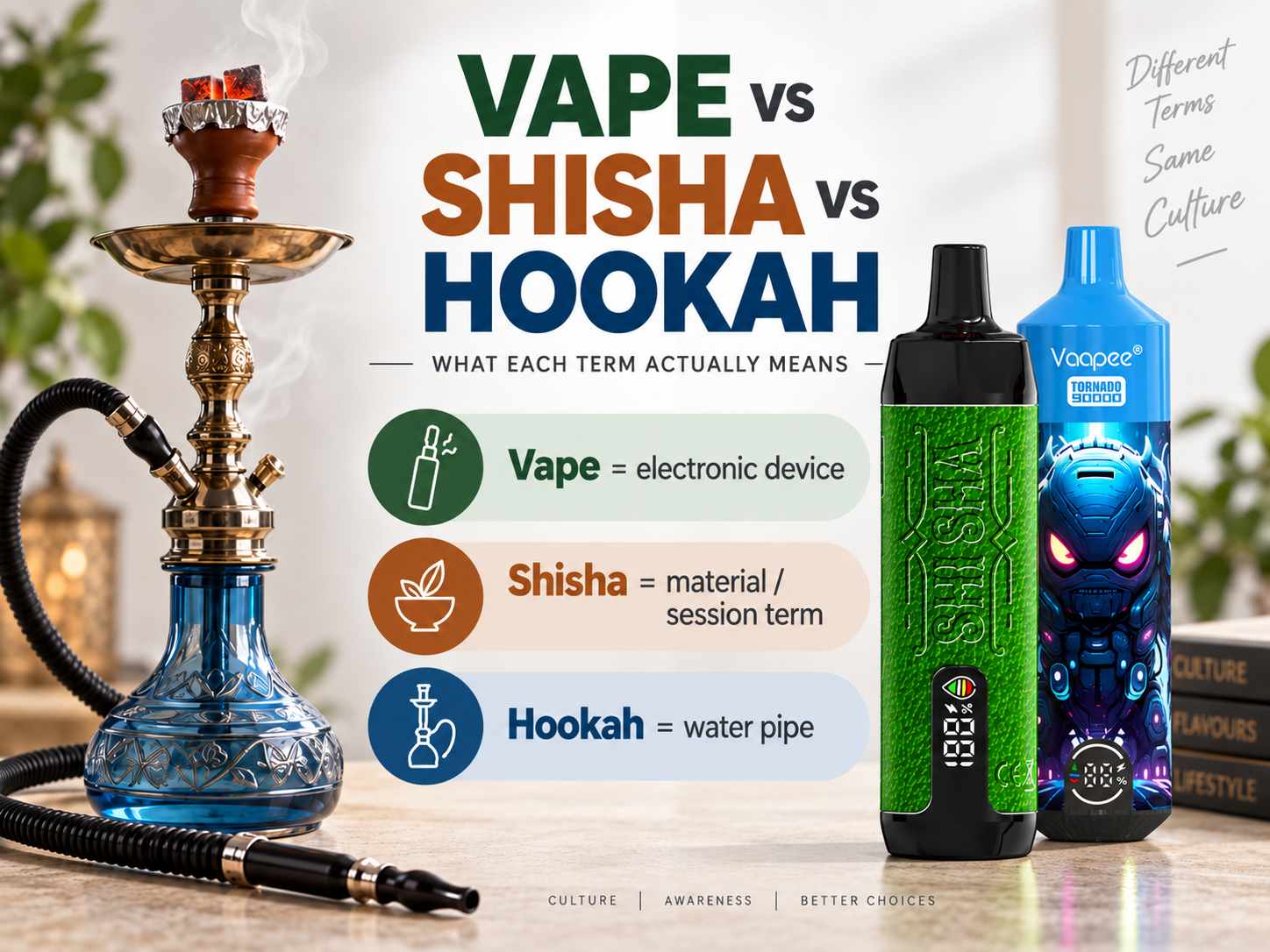
Vape vs Shisha vs Hookah: What Each Term Actually Means
Hookah is the water-pipe apparatus, shisha usually means the flavoured material used in it, and a vape is an electronic device that heats e-liquid to form an aerosol.
The terms become confusing because “shisha” can also mean the hookah session or pipe in everyday speech, while “e-shisha” and “vape hookah” are marketing labels rather than one standardised device category.
An electronic hookah product may be a charcoal-free heater for shisha, an e-liquid atomiser attached to a water pipe, or a handheld vape designed to produce shisha-style flavours and larger clouds. Those products do not all work in the same way.
Quick Definitions
| Term | Most precise meaning |
|---|---|
| Hookah | A water pipe used to draw smoke or aerosol through a water chamber and hose |
| Shisha | Usually a moist flavoured tobacco mixture used in a hookah; usage varies by region |
| Herbal shisha | A tobacco-free mixture heated in a hookah; it may still produce harmful emissions, especially when charcoal is used |
| Vape or e-cigarette | A battery-powered device that heats e-liquid to produce an aerosol |
| E-shisha | A broad marketing term for electronic products associated with shisha-style flavour, draw or appearance |
| Vape hookah | Another broad term that may describe a handheld vape or an electronic system used with a hookah body |
| E-head or electronic hookah head | An ambiguous term for an electronic component fitted to a hookah; its material and heating method must be checked |
What Is a Hookah?
A hookah is a water-pipe system. A conventional setup normally includes:
- a bowl or head holding shisha;
- a heat source, commonly charcoal;
- a stem leading into a water base;
- a hose and mouthpiece;
- seals and valves that control airflow.
When the user inhales, air is drawn across the heated shisha. The resulting smoke passes through the stem, bubbles through the water and travels through the hose.
“Hookah”, “waterpipe”, “narghile”, “argileh” and related regional terms can refer to similar apparatuses. Exact designs and vocabulary vary by country and culture.
What Is Shisha?
In its most precise product sense, shisha is the moist mixture placed in the hookah bowl. Traditional shisha commonly contains tobacco, sweeteners such as molasses or honey, glycerol and flavourings.
In everyday conversation, especially in parts of Europe, “shisha” may also refer to:
- the hookah pipe itself;
- the act of using a hookah;
- a hookah lounge;
- a flavour style associated with water-pipe products.
That is why the surrounding context matters. “Buying shisha” may mean buying the mixture, while “going for shisha” usually refers to the session.
What about tobacco-free or herbal shisha?
Tobacco-free material does not contain tobacco by definition, but that does not make the session harmless. Charcoal combustion can add carbon monoxide, fine particles, metals and other toxic substances. Heating flavourings and other ingredients can also generate emissions.
The absence of nicotine should not be presented as proof of an absence of health risk.
What Is a Vape?
A vape or e-cigarette uses a battery and heating coil to aerosolise e-liquid. During normal operation, it does not need charcoal and does not burn shisha tobacco.
E-liquid commonly contains propylene glycol, vegetable glycerine, flavourings and, in some products, nicotine. The technical output is an aerosol, although “vapour” is widely used in consumer language.
Vape devices include disposables, closed pod systems, refillable pods, vape pens and larger tank systems. Their airflow can range from a tight mouth-to-lung draw to an open direct-to-lung draw. See our MTL vs RDL vs DTL guide for the differences.
What Are E-Shisha and Vape Hookah?
Neither term describes one universally defined product. Check what the device actually heats and whether it uses a water pipe.
Type 1: Electronic heater for conventional shisha
Some electronic systems replace charcoal with an electrically powered heating element while still heating shisha material in a bowl. The hookah body, water chamber and hose remain part of the setup.
This can remove charcoal as the heat source, but it does not turn the product into an e-liquid vape. If the bowl contains tobacco shisha, it remains a tobacco-heating session.
Type 2: E-liquid atomiser fitted to a hookah
Other electronic heads contain a coil and e-liquid reservoir. They attach to a hookah body and send e-liquid aerosol through the stem, water and hose.
These systems are closer to e-cigarettes in their heating mechanism, even though the form factor and social use resemble a hookah.
Type 3: Handheld e-shisha or vape hookah
Many products sold as “e-shisha”, “shisha pens” or “disposable vape hookahs” are simply handheld vape devices. They do not use a water chamber or traditional hookah body. The shisha association comes from flavour, airflow, cloud style or branding.
A product can therefore be marketed as vape hookah without being a hookah in the mechanical sense.
Traditional Hookah vs Vape vs Electronic Hookah
| Feature | Traditional hookah with shisha | Handheld vape or e-shisha | Electronic system fitted to a hookah |
|---|---|---|---|
| Material heated | Usually tobacco shisha or herbal mixture | E-liquid | Shisha material or e-liquid, depending on system |
| Main heat source | Commonly charcoal | Battery-powered coil | Electrical heater or atomiser |
| Combustion source | Charcoal burns | No charcoal during normal use | Usually no charcoal, but design varies |
| Water-pipe body | Yes | No | Usually yes |
| Output | Smoke and particles from heated shisha and charcoal | E-liquid aerosol | Smoke or aerosol depending on material |
| Setup | Bowl packing, sealing, heat management and cleaning | Usually charge/fill/replace pod, depending on device | Device installation, charging, compatibility checks and hookah cleaning |
| Portability | Usually limited | Usually highest | Usually limited by the hookah body |
| Shared hose or mouthpiece | Common in social settings | Normally personal | Possible |
| Terminology | Relatively established | Relatively established | Often inconsistent across brands |
Does Hookah Water Filter Out the Harmful Substances?
No. The water does not make hookah smoke safe.
Passing smoke through water can cool it and change how it feels to inhale, but CDC and WHO guidance states that hookah smoke still contains toxic substances. Charcoal can add carbon monoxide, metals and cancer-causing chemicals, while the long duration of a session can increase total smoke exposure.
The same caution applies to vague claims such as “water-filtered vape”. Sending aerosol through water may change temperature, droplet size or sensory experience, but it should not be presented as proven removal of health risks without product-specific evidence.
Does Vape Hookah Need Charcoal?
Usually not—but the label alone is not enough.
- A handheld e-shisha uses a battery and coil, so it does not require charcoal.
- An e-liquid atomiser head fitted to a hookah also normally operates without charcoal.
- An electronic shisha heater replaces charcoal with electrical heat but may still heat tobacco-containing shisha.
- A conventional hookah normally uses charcoal unless another approved heat source is fitted.
This distinction matters because “charcoal-free” describes the heat source, not whether the product contains tobacco or nicotine.
Does E-Shisha Contain Nicotine?
It depends on what the term refers to and on the product formulation.
A handheld e-shisha may contain nicotine e-liquid or a nicotine-free liquid. An electronic heater used with conventional tobacco shisha can deliver nicotine from the tobacco even though the heater itself contains none. Herbal shisha may be nicotine-free, but charcoal and heated ingredients can still generate harmful emissions.
Always check the ingredient label, nicotine statement and market-specific product information. Do not infer nicotine content from flavour, cloud size or the words “shisha-style”.
Are E-Heads Universal?
No. “Universal” is often used loosely in product listings.
Compatibility can depend on:
- bowl or stem diameter;
- grommet size and seal;
- weight and centre of gravity;
- airflow resistance;
- power supply and charging specification;
- whether the head is designed for shisha material or e-liquid;
- cleaning and condensation management;
- the manufacturer's approved hookah configuration.
An incorrect fit can create air leaks, instability, overheating or liquid entering areas not designed for it. Use the dimensions and instructions for both the electronic head and hookah rather than assuming that every head fits every pipe.
Can Traditional Shisha Be Put Inside an E-Head?
There is no universal answer because “E-head” covers different products.
An electronic heater designed for shisha material may be intended to heat a packed bowl. An e-liquid atomiser head is not designed for moist shisha tobacco and should only use the liquid or cartridge system specified by its manufacturer.
Never place shisha, e-liquid, charcoal or other material into a device unless the instructions explicitly permit it.
What E-Liquid Ratio Works for Vape Hookah?
There is no single correct VG/PG ratio for every product.
High-VG liquid can produce dense aerosol in hardware designed for it, but it is also more viscous and may wick poorly in small coils or narrow liquid channels. A thinner liquid may leak or flood a system designed for higher viscosity.
Use only the liquid type and viscosity range approved for the specific coil or electronic head. The common claim that every e-shisha requires “70VG/30PG or higher” is too broad to be reliable.
How to Compare the Formats Responsibly
Rather than asking which format is universally “better”, compare the actual use case and product architecture.
| Question | Why it matters |
|---|---|
| What material is heated? | Distinguishes tobacco shisha, herbal material and e-liquid |
| Is charcoal used? | Identifies an additional combustion source |
| Is there a water-pipe body? | Separates mechanical hookah systems from handheld vapes |
| Is the product shared? | Shared hoses and mouthpieces require hygiene controls |
| What maintenance is required? | Hookah bodies, hoses, pods and atomisers have different cleaning needs |
| Is nicotine present? | Must be confirmed from the product, not inferred from the category |
| Is the product legal in the target market? | Tobacco, vaping, flavour and online-sale rules differ by country |
| Are replacement parts available? | Electronic heads may depend on proprietary coils, seals or cartridges |
Neither hookah smoking nor vaping is risk-free. Adults who do not use tobacco or nicotine products should not start.
Frequently Asked Questions
Is shisha the same as hookah?
Technically, no. Hookah is the water-pipe apparatus, while shisha usually means the flavoured material placed in its bowl. In everyday speech, people may use “shisha” for the pipe or session.
Is vape smoke the same as hookah smoke?
No. A vape produces e-liquid aerosol during normal operation. A conventional hookah produces smoke from heated shisha and burning charcoal. Both can expose users and bystanders to substances that are not harmless.
Is e-shisha just a disposable vape?
Sometimes, but not always. Handheld disposable products are frequently marketed as e-shisha. The term can also describe refillable vapes or electronic components used with a hookah body.
Does an electronic hookah still use water?
A device fitted to a conventional hookah usually sends its smoke or aerosol through the water base. A handheld e-shisha generally has no water chamber.
Does a vape hookah contain tobacco?
It depends on the system. An e-liquid vape hookah normally does not use tobacco leaf, while an electronic heater for conventional shisha may still heat tobacco-containing material.
Is nicotine-free e-shisha harmless?
No. Nicotine-free only states that nicotine is absent or below a stated threshold. It does not establish that inhaling the aerosol or smoke is harmless.
Can an E-head replace charcoal?
Some electronic hookah heaters are designed to replace charcoal. Other products called E-heads are e-liquid atomisers rather than shisha heaters. Check the manufacturer's definition and approved materials.
Does hookah water remove nicotine or toxins?
It does not make the smoke safe. Public-health authorities state that toxic substances remain after the smoke passes through water.
Bottom Line
Hookah, shisha and vape are related in modern marketing but describe different things. Hookah is the water pipe, shisha is usually the material heated in it, and a vape is a battery-powered e-liquid aerosol device.
“E-shisha”, “vape hookah” and “E-head” are not standardised enough to explain a product by themselves. Determine whether the device heats shisha or e-liquid, whether charcoal is used and whether a water-pipe body is involved.
Most importantly, do not treat water filtration, charcoal-free heating or zero-nicotine labelling as proof that a product is harmless.
Official Sources
This article provides general information for adults of legal vaping or tobacco age. It is not medical or legal advice. Product definitions and laws vary by market; verify the manufacturer's instructions and current local requirements before purchase, sale or use.