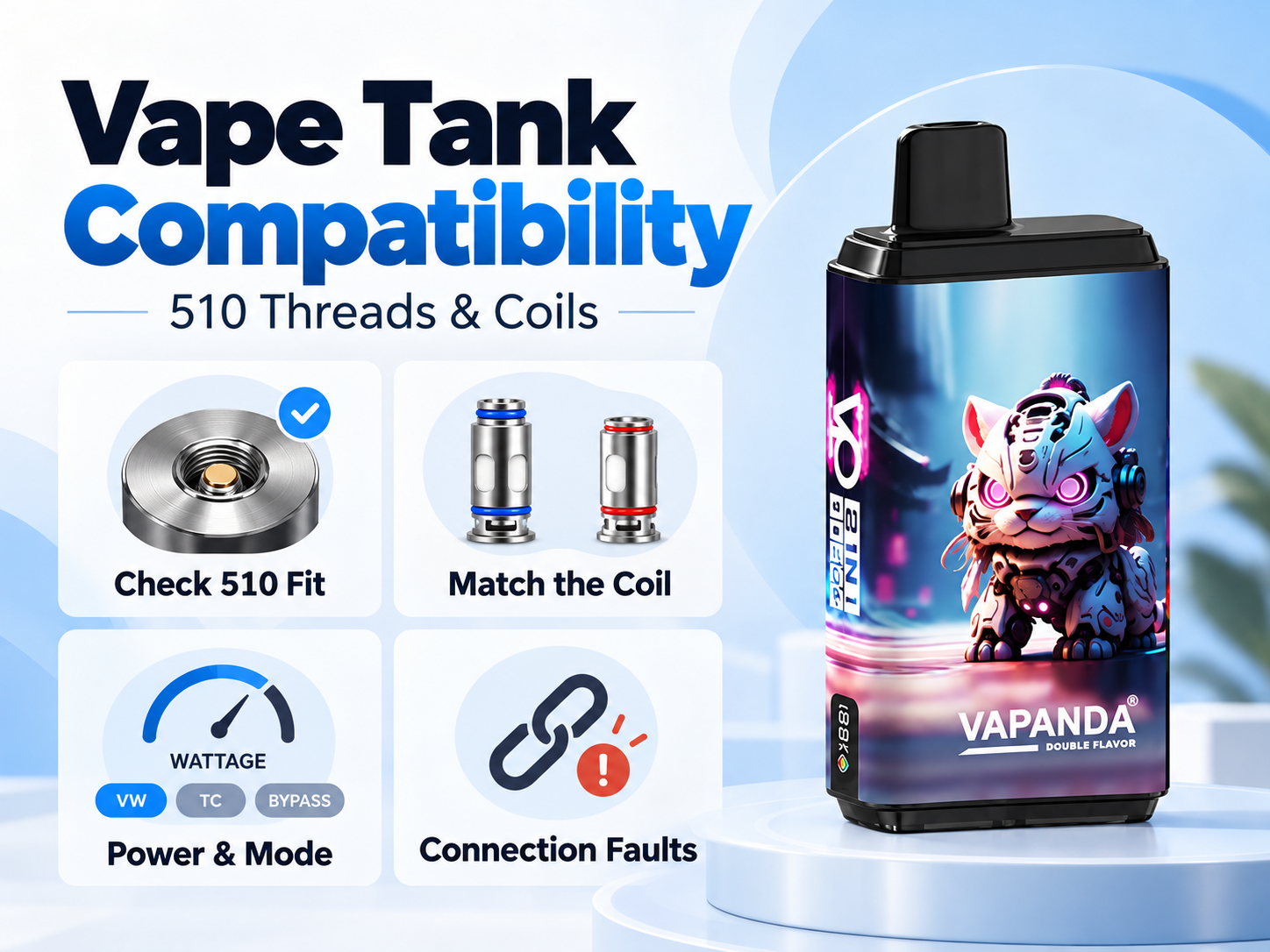
Vape Tank Compatibility Guide for 510 Threads and Coils
A tank that screws onto a mod is not necessarily compatible with it. The connector, installed coil, output limits, operating mode and physical clearance all need to suit the combination.
This guide covers conventional tanks with manufactured replacement coils and regulated mods. Mechanical and hybrid-style devices require different checks and are outside this guide's scope. Always use the exact model instructions when inspecting or combining parts.
What the 510 connection does
Many separate vape tanks use a 510 fitting that combines threaded attachment with electrical contacts. In a typical arrangement, the tank screws into the mod's socket, and an insulated central contact forms part of the electrical connection.
The fitting does not specify which replacement coil belongs inside the tank, what power it needs or whether the mod can supply it. It also does not establish compatibility with proprietary pods, refill ports, mouthpieces or seals.
Five checks before attaching a tank
| Check | What must match | What a matching thread cannot prove |
|---|---|---|
| Mechanical fitting | Connector type, intact threads and sufficient clearance | The tank will seat securely without interference |
| Replacement coil | Exact tank model and approved coil family | A similar-looking coil belongs in the tank |
| Electrical limits | Supported resistance, voltage, current and power | The mod can operate the coil throughout its required range |
| Operating mode | Coil material and manufacturer-approved mode | Temperature control is appropriate for the installed coil |
| Device condition | Dry contacts, intact insulation and undamaged components | Used or damaged equipment remains serviceable |
1. Check the fitting and clearance
Switch off the mod and disconnect charging power before inspection. Let the tank cool, then check accessible threads and the connector for damage, debris or liquid.
A compatible fitting should engage smoothly by hand. If it catches immediately, sits at an angle or requires force, stop. Cross-threading or overtightening can damage the connector.
Check the tank diameter and the space around the device body, buttons and airflow openings. A visible gap alone is not proof of a fault, but loose seating, a tilt or physical interference requires further checking. Do not tighten harder simply to eliminate a gap.
2. Identify the exact coil
Coil compatibility is determined inside the tank, not by the external 510 fitting. Check the tank model, coil family, seals and installation method.
The same resistance value does not make two coils interchangeable. For example, Aspire's Nautilus 2S compatibility guidance lists supported coils and also excludes a particular Nautilus AIO coil. A related family name is therefore insufficient to establish compatibility.
Use the approved part number or the manufacturer's current compatibility list. If a seller's listing conflicts with it, resolve the discrepancy before installation.
3. Compare electrical requirements
Check the installed coil's resistance and recommended wattage range against the mod's supported output. A mod's maximum wattage is only one limit; its output voltage and current can also constrain operation.
As an illustration, a coil marked 20–30 W does not become suitable for a device that can deliver only 15 W merely because the tank fits. Likewise, a device rated for much higher power does not authorise using the coil above 30 W. These numbers illustrate the check, rather than recommending a setting for any product.
The Evolv DNA 75 manufacturer's manual documents output limits, resistance-dependent operation and fault messages for that specific controller. Its numerical limits must not be transferred to an unrelated mod.
4. Match the operating mode
Temperature-control modes depend on suitable coil materials and the correct device configuration. A coil designed for ordinary wattage operation should not be assumed suitable for any temperature-control setting.
Follow the exact coil and mod instructions. Do not choose a material profile by guessing from coil resistance or appearance.
5. Confirm the equipment is intact
Do not use a damaged mod, torn battery wrap, broken connector insulation or a tank that leaks into the electronics. Use only the battery types specified for the device. The FDA's battery guidance reinforces the need to follow device and battery instructions.
Common fit and connection problems
The tank will not screw on
Possible causes include a different fitting, debris, damaged threads or misalignment. With power off, inspect accessible surfaces. Do not use tools to force a fit or attempt to cut new threads.
The device shows No Atomiser or Check Atomizer
The mod may not detect a usable electrical connection. An incorrectly installed coil, dry-contact obstruction, unsupported resistance or a failed component may be involved. Error meanings vary by device.
Check that the exact approved coil is correctly installed and that accessible contacts are dry. If the message remains, follow the manufacturer's fault procedure. Do not pry out contact pins, remove insulation or bypass protection.
A short-circuit warning appears
Stop activating the device. A short warning is not an invitation to raise power, alter a pin or keep trying until it fires. Inspect only the components the instructions permit, and obtain manufacturer support if the fault persists.
The resistance reading changes unexpectedly
A small change with coil temperature can occur with some materials. A large unexplained jump, repeated connection loss or a fault message is different: stop using the setup and check installation and component condition.
Do not repeatedly fire a suspect coil to test whether it will settle. If an approved replacement does not resolve the problem, the tank or mod may require inspection.
The tank fits but produces poor output
Recheck the coil family, recommended power range and operating mode. Weak output does not prove the connector is faulty, and increasing power outside the coil's range is not a general solution.
Tanks and pods have different compatibility checks
Most proprietary pods use dedicated contacts and attachment shapes. A pod may attach magnetically yet still belong to a different device version. Tanks that share a 510 interface can also use entirely different internal coil families.
Adapters add another component to verify. Their physical fit does not establish electrical suitability, and they should only be used in combinations explicitly supported by the relevant manufacturers.
A short compatibility procedure
- Record the exact tank, mod and coil identifiers.
- Read their supported connector, coil and output specifications.
- Confirm the operating mode and battery requirements.
- Inspect accessible fitting surfaces with power off.
- Attach by hand without forcing or overtightening.
- If the device reports a fault, stop and follow its instructions.
Once compatibility is established, follow the vape tank maintenance guide for routine care. Cleaning will not convert incompatible parts into a supported combination.
Frequently asked questions
Are all 510 tanks interchangeable?
No. The connector is one compatibility factor. The coil, electrical requirements, operating mode and dimensions must also suit the device.
Can I use coils from a different brand?
Only when the specific coil and tank combination is confirmed as compatible. Matching resistance is not sufficient evidence.
Why does a tank fit but still show an error?
The mechanical fitting may work while an electrical connection or installed coil does not. Use the model's error guidance to check the appropriate components.
Should I adjust the 510 pin to make the tank work?
Do not improvise pin adjustments. Follow an explicit manufacturer-approved procedure or seek service for the component.
Does every gap between tank and mod mean a fault?
No. Connector designs vary. A loose, tilted or obstructed fitting needs checking, while a small stable gap should be assessed against the product instructions.
Adult use notice
This guide is for adults of legal vaping age. Nicotine is addictive, and vaping is not risk-free. Keep vaping products away from children and pets, and follow product-specific instructions and local laws.