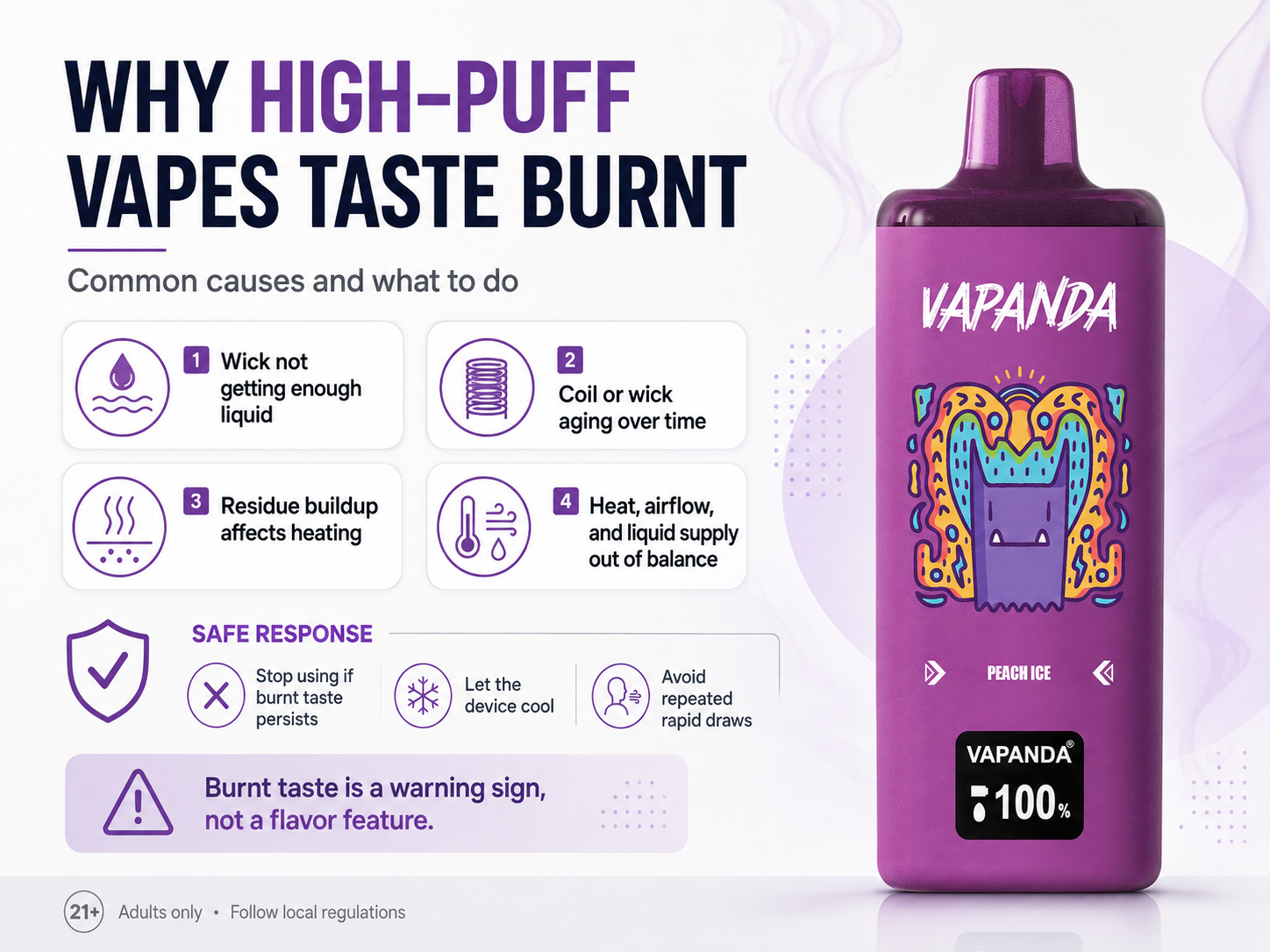
Why Does a High-Puff Vape Taste Burnt? Wicking, Heat and Coil Age
A high-capacity vape can produce a burnt, dry or unusually harsh taste before the device appears empty. The most common explanation is not the advertised puff number. It is a local imbalance between heat generation and the amount of e-liquid reaching the heating area.
A persistent burnt taste is a warning, not a flavour feature. Stop using the device while you identify the cause. Continuing to heat a dry or damaged wick can worsen the problem and may increase thermal degradation products in the aerosol.
First: what does “high-puff” mean?
Puff counts printed on a product are manufacturer-rated estimates. Actual use varies with:
- Puff duration
- Airflow
- Output mode
- Coil and wick design
- E-liquid capacity and formulation
- Battery behaviour
- User frequency
- Test method
A puff rating is not a guarantee of identical flavour, coil condition or usable life for every device. A meaningful product claim should disclose the test method and conditions.
Main causes of a burnt taste
1. The wick is not receiving liquid fast enough
The wick moves e-liquid from the reservoir to the heating surface. If the coil heats faster than the liquid can return, part of the wick may become too dry.
This can occur when:
- Draws are repeated with little recovery time
- The liquid level is low or no longer reaches the wick consistently
- The liquid is too viscous for the design or current temperature
- An air pocket interrupts liquid contact
- The wick is compressed, damaged or partly blocked by residue
Research on “dry puff” conditions has found that overheating liquid can create a strong unpleasant taste and substantially increase certain aldehydes. The exact emissions depend on the device and test conditions, so this should not be converted into a universal temperature or puff limit.
2. The wick or coil has aged
Heating and cooling occur repeatedly during use. Over time, the wick may become discoloured, lose its ability to transport liquid evenly or become permanently scorched. Deposits can also form on the heating surface.
Once wicking material is physically charred, resting or adding liquid does not restore it. A replaceable coil or pod should be replaced. A sealed device with persistent burnt taste should no longer be used.
3. E-liquid components and residue affect heating
E-liquid chemistry varies widely. Carrier liquids, flavour compounds, nicotine formulations and sweeteners can respond differently to heat.
Some e-liquids contain sucralose. Laboratory research has shown that sucralose can degrade in e-cigarette conditions and can increase the formation of solvent degradation products, including aldehydes, hemiacetals and potentially harmful organochlorine compounds.
This does not mean every sweet-tasting e-liquid contains sucralose, that sucralose is the only cause of residue, or that every coil follows the same degradation pathway. Ingredient data and product-specific testing are needed before making that conclusion about a particular device.
4. Power, airflow and liquid supply are mismatched
In an adjustable device, power above the coil's rated range can heat the coil faster than the wick can supply liquid. Very restricted airflow may also change cooling around the heating area.
In a sealed device, users may not be able to change these settings. Irregular output, unexpected heat, flickering, an electrical smell or activation problems can indicate a device fault. Stop using the product rather than trying to repair or bypass its controls.
A discharging battery does not automatically create power spikes. Regulated devices use control electronics to manage output, and the behaviour depends on the actual circuit. Claims about constant voltage, intelligent alternation or thermal protection require product documentation and test data.
5. The device is damaged or leaking internally
Impact, heat exposure, manufacturing defects or an internal leak can affect liquid delivery and electrical safety.
Stop using the device immediately if you notice:
- Battery swelling
- Cracks or deformation
- Abnormal heat when idle
- Smoke, sparking or an electrical smell
- Liquid near a battery or charging port
- Uncontrolled or delayed activation
Do not open a sealed disposable device or attempt to remove an embedded battery.
What mesh coils can and cannot tell you
A mesh heating element commonly uses a wider patterned or woven conductive structure instead of a simple round-wire coil. Depending on the design, this can provide more heating surface and may support more even contact with the wick.
However, the word mesh does not guarantee:
- No hot spots
- No dry hits
- No residue
- Constant flavour to the end of the liquid
- A particular coil lifespan
- Safer aerosol
Performance still depends on material, geometry, wick contact, liquid formulation, airflow, power control, manufacturing consistency and ageing.
What “dual mesh” may mean
Dual-mesh products do not all work in the same way. The term may refer to:
- Two coils used together
- Separate coils for separate flavour chambers
- Selectable operating modes
- Alternating elements controlled by a chipset
Do not assume the coils alternate or receive recovery time unless the product specification and circuit documentation say so. Marketing language is not a substitute for a wiring diagram, control description and performance test.
How to respond safely to a burnt taste
1. Stop and let the device cool
Do not continue taking test puffs from a device that tastes strongly burnt or feels unusually hot.
2. Check the product instructions
Confirm whether the device has:
- A refillable reservoir
- A replaceable coil or pod
- A minimum liquid level
- Adjustable power or airflow
- A stated recovery or priming procedure
Do not apply refillable-tank instructions to a sealed product.
3. Inspect only user-serviceable parts
For a refillable system, check the liquid level, coil age, compatible power range, airflow and visible seals. Replace damaged or exhausted consumables.
For a sealed product, do not puncture, refill, open or bypass it. If the burnt taste persists, stop using it and follow local disposal guidance.
4. Avoid repeated rapid draws
Repeated use can outpace liquid supply in some designs. Allow normal recovery time according to the manufacturer. A universal 15- or 30-second rule cannot be guaranteed for every product.
5. Charge safely
Use the cable, charger and charging conditions permitted by the manufacturer. Charge on a clean, flat and visible surface away from flammable materials. Do not charge unattended or continue using a damaged device.
Whether a device supports use while charging is product-specific. Do not assume pass-through operation is safe unless the manufacturer explicitly permits it.
How to evaluate high-capacity coil claims
Before accepting claims such as “prevents burnt hits” or “consistent flavour to the last puff,” ask for evidence.
| Evidence | What it should show |
|---|---|
| Product specification | Coil number, resistance, material, liquid capacity and operating modes |
| Control description | Whether coils fire together, separately or in alternation |
| Puff test method | Puff duration, interval, airflow, mode, sample size and end point |
| Temperature or power data | Output stability and relevant test conditions |
| Ageing test | Performance across multiple devices, not one selected sample |
| Emissions test | Accredited method, laboratory, operating conditions and analytes |
| Failure testing | Leakage, dry-hit, charging, transport and abnormal-use scenarios |
Without this information, use qualified language such as “designed to support” rather than prevents, eliminates or ensures.
Frequently asked questions
Why does a vape taste burnt when liquid is still visible?
Visible liquid does not prove that the wick next to the heating element is fully saturated. Liquid may not be reaching the coil fast enough, or the wick may already be damaged.
Can a burnt coil repair itself?
No. Temporary wicking delay may improve after the device rests, but physically scorched wick material does not repair itself. If the burnt taste returns or persists, stop using the device and replace the user-serviceable part or dispose of the sealed device appropriately.
Are mesh coils less likely to produce dry hits?
Some mesh designs may distribute heat more evenly, but the result is product-specific. Mesh alone does not prevent dry hits.
Are dual-mesh coils automatically better?
No. “Dual mesh” describes a configuration, not a verified performance outcome. Compare documented design, test conditions and failure data.
Should I keep using a device until the advertised puff count is reached?
No. Stop earlier if the device tastes burnt, leaks, overheats, becomes damaged or behaves abnormally. The puff number is an estimate, not a requirement to continue use.
Final thoughts
Burnt taste is mainly a heat-and-liquid-supply warning. Wicking delay, coil age, residue, incompatible settings and device damage can all contribute.
Responsible technical content should separate general mechanisms from product-specific evidence. Mesh, dual mesh and power-management terms may describe useful design choices, but they do not prove a device will avoid dry hits or maintain identical performance throughout an advertised puff count.
Adult-use and safety notice
This article is intended for adults of legal smoking or vaping age and provides general technical information, not medical advice. Nicotine is addictive, and vaping is not risk-free. Adults who do not use tobacco or nicotine products should not start. Keep devices and e-liquids away from children and pets and follow local laws, manufacturer instructions and disposal requirements.
References
- Farsalinos et al.: E-cigarettes generate high levels of aldehydes in dry-puff conditions
- Duell et al.: Sucralose-enhanced degradation of electronic cigarette liquids
- El-Hellani et al.: E-liquid composition, coil temperature and puff topography
- FDA: Tips to Help Avoid Vape Battery Fires or Explosions