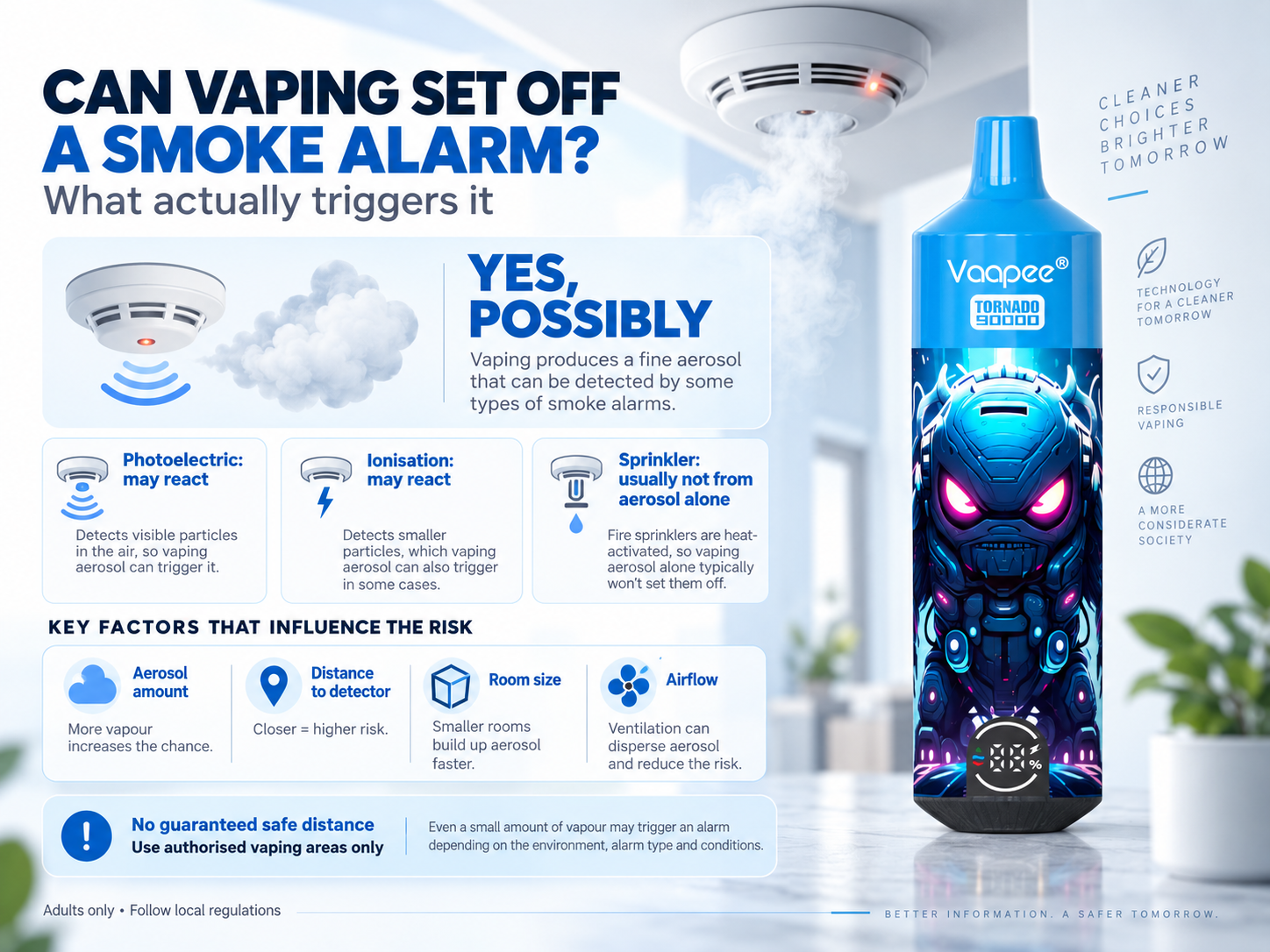
Can Vaping Set Off a Smoke Alarm? What Actually Triggers It
Yes. Vaping can set off a smoke alarm when enough aerosol reaches the detector's sensing chamber.
An e-cigarette does not produce combustion smoke during normal use. It heats e-liquid and creates an aerosol made of tiny airborne droplets and particles. Smoke alarms do not need to identify the source of every particle; some react when airborne material changes the light or electrical conditions inside the detector.
That means there is no guaranteed safe number of puffs, safe device type, safe room or safe distance from a smoke alarm. Detector design, sensitivity, aerosol output, room size, airflow and placement all affect the result.
The Quick Answer by Detector Type
| Device | What it normally detects | Can ordinary vape aerosol activate it? |
|---|---|---|
| Photoelectric smoke alarm | Light scattered by airborne particles | Yes, potentially |
| Ionisation smoke alarm | Changes in electrical current caused by particles | Yes, potentially |
| Building fire-alarm system | Signals from connected smoke, heat or other sensors | Yes, if a connected detector activates |
| Heat detector | A defined temperature or rate of temperature rise | Usually not from aerosol alone |
| Carbon monoxide alarm | Carbon monoxide gas | Not for the same reason as a smoke alarm |
| Automatic fire sprinkler | Heat at the individual sprinkler head | Ordinary vape aerosol does not normally open a sprinkler head |
| Dedicated vape detector | Aerosol signatures and, in some systems, other environmental signals | It may detect vaping without a smoke alarm sounding |
A ceiling-mounted device cannot always be identified accurately by appearance. Do not test, cover or interfere with it. Follow the building's fire-safety and vaping rules.
Why Vape Aerosol Can Trigger a Smoke Alarm
The CDC explains that e-cigarette emissions are not harmless "water vapour". The aerosol can contain nicotine, ultrafine particles, flavouring-related chemicals, volatile organic compounds and metals, depending on the product and conditions of use.
For alarm activation, the key issue is simpler: the aerosol contains airborne material that can enter a particle-sensitive detector.
Photoelectric smoke alarms
A photoelectric alarm contains a light source and a sensor. Under normal conditions, little or no light reaches the sensor. When particles enter the chamber, they can scatter light towards it. If the signal reaches the alarm threshold, the alarm sounds.
A concentrated cloud of vape aerosol can therefore cause a nuisance alarm, especially when released close to the detector or carried towards it by airflow.
Ionisation smoke alarms
An ionisation alarm uses a small electrical current inside a sensing chamber. Airborne particles can disturb that current. If the change reaches the detector's threshold, the alarm activates.
Ionisation and photoelectric alarms respond differently to different particle sizes and fire types, but neither should be considered "vape-proof". NIST testing has shown that nuisance-aerosol response varies with the aerosol, detector, concentration and test conditions.
What Makes an Alarm More Likely to Go Off?
1. More aerosol in the air
Larger clouds and repeated puffs increase the amount of aerosol that may reach a detector. Device format alone is not a reliable guide: disposable, pod and refillable devices can all produce very different aerosol volumes depending on power, airflow, coil design and use.
For an explanation of how draw style and airflow affect output, see our guide to MTL, RDL and DTL vaping.
2. Shorter distance to the detector
Aerosol released close to an alarm has less time to dilute before entering the sensing chamber. However, distance is not the only variable, so a measurement that appeared not to trigger one detector cannot be treated as a rule for another room.
There is no universal safe distance from a smoke alarm for vaping.
3. Small or enclosed rooms
Aerosol can build up faster in a small bedroom, bathroom, vehicle or hotel room than in a large, open space. Ceiling height, door position and the location of the alarm also matter.
4. Airflow and ventilation
Windows, extractor fans, desk fans, air conditioning and mechanical ventilation change where aerosol travels. They may dilute it, but they may also carry it directly towards a detector or into a return-air system.
Opening a window or turning on a fan is therefore not a reliable way to prevent detection.
5. Detector sensitivity and system design
Detectors differ by technology, age, sensitivity, maintenance status and installation. Commercial buildings may also use networked systems in which one detector sends a signal to a control panel, security desk or wider alarm system.
Can Vaping Set Off a Hotel Fire Alarm?
Yes. Hotel rooms are often compact, and their smoke detectors may be connected to a monitored building system. A local detector can therefore lead to a wider alarm response, a staff inspection or charges under the property's policy.
A bathroom is not a dependable workaround. It may still contain a detector, and extractor airflow can move aerosol beyond the bathroom. Hotels may also use dedicated environmental or vape-detection sensors that do not work like ordinary smoke alarms.
The practical rule is straightforward: use only an authorised smoking or vaping area and follow the property's policy.
Can One Puff Trigger a Smoke Detector?
It is possible, but there is no universal answer.
One small puff in a large, well-mixed space may disperse without reaching the alarm threshold. A dense puff close to a sensitive detector, or one carried directly into it, may behave differently. Without knowing the detector, room and airflow, "one puff is safe" is not a defensible rule.
Are Disposable Vapes Less Likely to Set Off an Alarm?
Not necessarily. "Disposable" describes the product format, not a fixed aerosol output.
A compact disposable may produce a smaller cloud than a high-power refillable device, but other disposable products are designed for high airflow and dense aerosol. The alarm responds to what reaches its sensing chamber, not to the label used for the device.
Smoke Alarm, Sprinkler and CO Alarm: Do Not Confuse Them
Smoke alarm or smoke detector
This is the device most likely to respond to vape aerosol because it is designed to detect airborne particles associated with smoke.
Heat detector
A conventional heat detector responds to temperature rather than particles. Vape aerosol by itself would not normally activate it, although the same room may also contain a smoke detector.
Fire sprinkler
A standard closed-head sprinkler is activated by heat at that individual sprinkler head, not by a nearby smoke cloud. Vaping would not normally cause a sprinkler head to open. It could still activate a separate smoke detector and trigger the building alarm.
Carbon monoxide alarm
A CO alarm is designed to detect carbon monoxide gas. It performs a different function from a smoke alarm. Combination units may contain more than one sensor, so check the product label or building information rather than guessing.
What Should You Do If an Alarm Sounds While Vaping?
Treat every alarm as real until you have confirmed otherwise.
- Stop vaping immediately.
- Check for flames, visible smoke, unusual heat, a burning smell or an electrical fault only if it is safe to do so.
- Leave the area and follow the building's emergency procedure if there is any sign of fire or if evacuation is required.
- In a hotel, workplace or managed building, follow staff and fire-service instructions.
- Do not remove batteries, cover the detector or try to silence a building system unless authorised emergency instructions specifically tell you to do so.
Never cover, disconnect, remove or disable a smoke alarm. Doing so can delay warning during a real fire and may violate building rules or local law.
Frequently Asked Questions
Can vape aerosol set off a photoelectric smoke alarm?
Yes. Photoelectric alarms detect light scattered by airborne particles. A sufficient concentration of vape aerosol can affect the sensing chamber and cause an alarm.
Can vaping set off an ionisation smoke alarm?
Yes, potentially. Particles can alter the electrical current inside an ionisation detector. The response depends on the aerosol and detector conditions.
Does opening a window stop a vape from setting off an alarm?
No guarantee exists. A window may dilute aerosol, but airflow can also move it towards the alarm.
Is there a safe distance for vaping near a smoke detector?
No universal safe distance can be stated. Placement, sensitivity, room dimensions, airflow and aerosol concentration all matter.
Can vaping in a bathroom trigger a hotel alarm?
Yes. Bathrooms are often small, ventilation can redistribute aerosol, and the room may have connected smoke or dedicated vape detectors.
Can a smoke alarm tell the difference between vape aerosol and fire smoke?
An ordinary particle-based alarm does not perform a complete chemical identification of the source. It responds when conditions in its sensing chamber cross a threshold. More specialised systems may use additional sensors or algorithms, but their capabilities are product-specific.
Should I cover a smoke detector while vaping?
No. Never obstruct or disable fire-safety equipment.
Bottom Line
Vaping can set off a smoke alarm because vape aerosol contains airborne particles that may enter the detector's sensing chamber. The likelihood changes with aerosol output, distance, airflow, room size, detector type and sensitivity.
There is no guaranteed safe puff count, device type, room or ventilation method. Where indoor vaping is prohibited, use an authorised area. Whatever the setting, keep all smoke alarms and fire-safety equipment fully operational.
Official Sources
- NIST — How Do Smoke Detectors Work?
- NIST — Smoke Detector Response to Nuisance Aerosols
- CDC — About E-Cigarettes (Vapes)
- U.S. Fire Administration — Smoke Alarms
This article provides general information for adults of legal vaping age. It does not replace local fire codes, property rules, emergency instructions or the manufacturer's guidance for a specific alarm system.