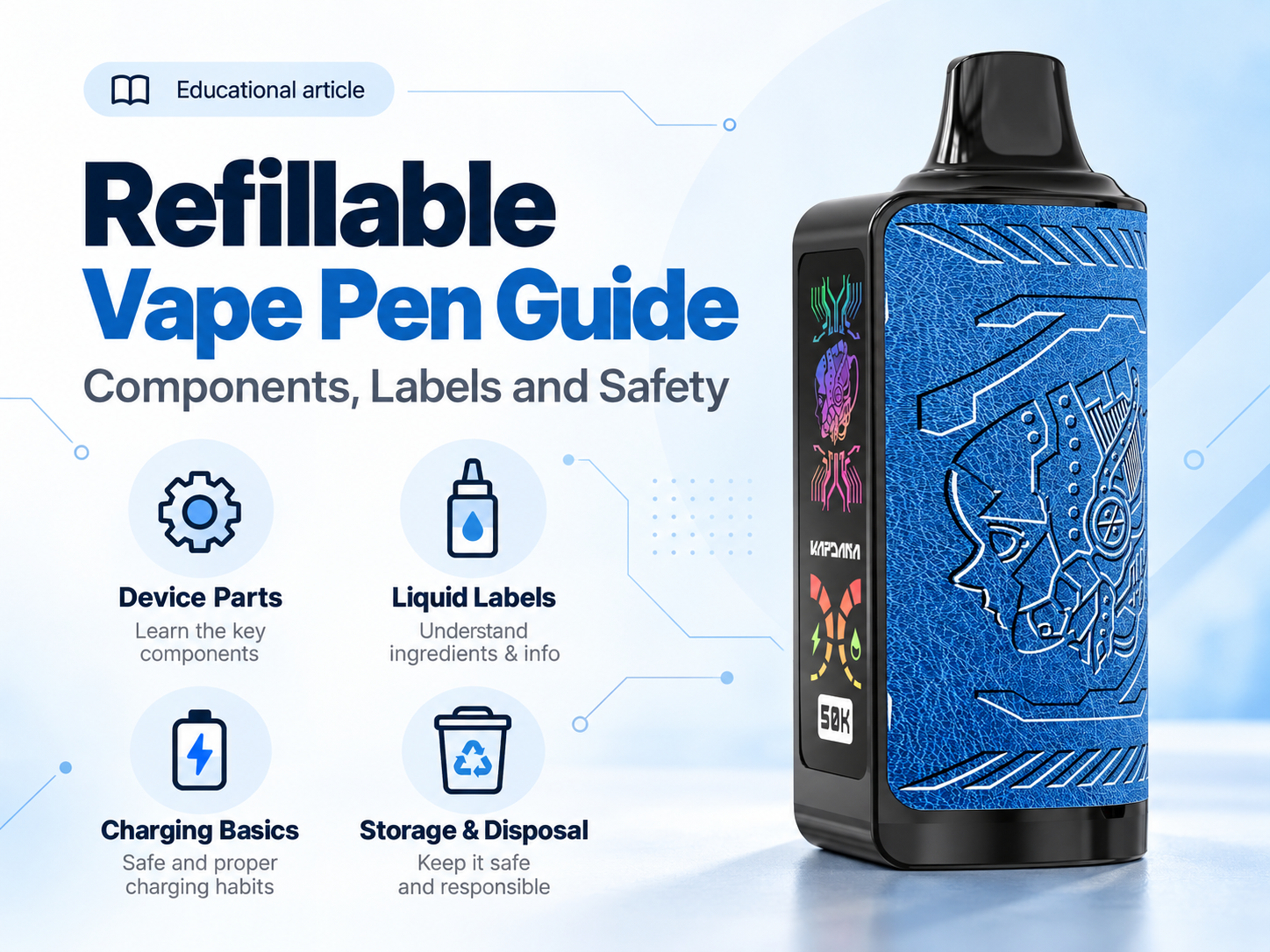
Refillable Vape Pen Guide: Components, Labels and Safety
A refillable vape pen is a device whose liquid reservoir is intended to be refilled. Rechargeable and refillable do not mean the same thing. A device may support battery charging while using a sealed, non-refillable liquid unit. 1
This guide explains the terminology, component information and safety limitations relevant to adults who already use vaping products. It is not a buying recommendation, an invitation to start vaping or a substitute for a model-specific manual.
What Is a Refillable Vape Pen?
“Vape pen” is a broad description, often referring to the device’s shape. It does not identify a single technical standard. A refillable model usually includes a battery section, a liquid reservoir, a heating element, a liquid-delivery structure and a mouthpiece. 1
| Component | What it does | What its name does not establish |
|---|---|---|
| Battery section | Supplies electrical energy | Guaranteed runtime or safe compatibility with every charger |
| Pod or tank | Holds liquid | Whether it is refillable without checking its design |
| Heating element or coil | Heats liquid delivered to it | A universal power setting or replacement interval |
| Wick or liquid-delivery structure | Supplies liquid to the heated area | That every liquid formulation is suitable |
| Airflow path and mouthpiece | Provide the aerosol pathway | A particular nicotine dose |
Some devices have a separate coil; others integrate the heating component into a replaceable pod. Replacing a pod and replacing an entire battery device are different maintenance actions.
Refillable, Pre-Filled and Disposable: Keep the Terms Separate
A refillable device has a reservoir intended for repeated filling. A pre-filled pod system can retain a reusable battery while its sealed cartridge is replaced. A disposable may have a rechargeable battery without being designed for reservoir refilling. 1
The presence of a charging port is therefore not permission to open a sealed unit. Likewise, a removable mouthpiece is not necessarily a refill opening.
These terms describe intended operation. They do not establish environmental impact, long-term cost or health risk without further evidence.
How Does It Work?
Electrical energy heats liquid at the heating element. The resulting emission is an aerosol, even though it is commonly called “vapour.” It should not be described as harmless water vapour. 1
The reservoir, liquid-delivery structure, heating system and electronics operate together. A change in output can have more than one possible cause, so a general guide cannot diagnose a particular device from one symptom alone.
Types of Refillable Devices
Pod-Based Systems
These use a pod containing the liquid reservoir. The pod may have an integrated heating component or accept a replaceable one. Refill access and permitted maintenance depend on the model.
Tank-Style Devices
These use a tank assembly. The distinction from a pod is about construction, not an automatic guarantee of larger legal capacity, more power or better quality. Device terminology is not completely uniform. 2
Adjustable Devices
Some models allow changes to power or airflow. Adjustability is a separate feature from refillability. More available settings do not demonstrate superior safety, and an online guide should not replace the manufacturer’s operating limits.
Refilling: Why the Exact Instructions Matter
There is no universal refilling procedure that fits every pen, tank and pod. Port design, seals, permitted fill level and initial preparation differ.
Before handling an existing device, establish from its manual that the reservoir is genuinely refillable and identify the designated filling point. Do not pour liquid into an electrical section or open a sealed cartridge to create a refill opening.
A new heating component may require time for its wick to become saturated. A generic “3–5 minutes” or “5–10 minutes” should not be presented as a guarantee for every design. Follow the product’s preparation instructions, and do not activate a dry heating component.
The same applies to fill levels. Follow the marked limit or documented method rather than an invented rule that every reservoir should be filled to 80%. Stop handling a unit that is cracked, leaking into the electronics or otherwise damaged.
These are safety boundaries, not a model-specific setup sequence. If the instructions are absent or unclear, seek clarification from the manufacturer before use. 3
Understanding E-Liquid Labels
Nicotine form, nicotine concentration and PG/VG ratio are separate pieces of information. The words “nicotine salts” do not establish a universal liquid ratio or prove suitability for every pod.
Concentration describes nicotine in the liquid, not a known amount absorbed in each puff. The solvent mixture and device operation also affect what is emitted; laboratory research illustrates why these variables cannot be reduced to a salt-versus-freebase rule. 4
For an existing device, use its exact liquid and component specifications. Neither “pod,” “sub-ohm” nor “MTL” is sufficient by itself to establish safe compatibility. This guide does not recommend a nicotine strength.
MTL and RDL Terminology
MTL means mouth-to-lung; RDL means restricted direct-to-lung. These terms describe inhalation styles and related airflow characteristics. They are not safety certifications, nicotine-dose measurements or universal compatibility standards.
A label mentioning either style does not remove the need for the exact pod, coil and liquid documentation.
Interpreting Battery and Charging Specifications
Battery capacity in mAh measures electrical charge, not a guaranteed number of puffs. A runtime comparison also depends on voltage, power demand, device efficiency and battery condition. A larger mAh figure alone cannot establish how two different devices will behave.
USB-C identifies a connector format. It does not, by itself, establish fast-charging support or the permitted input conditions. Read the charging specification rather than assuming a connector shape supplies the whole answer.
Follow the manufacturer’s charging requirements. Charge on a visible, clean, flat surface away from flammable materials, and avoid extreme temperatures. FDA advises understanding the device’s care instructions and battery requirements. 3
Common Problems: Symptoms Are Not Diagnoses
| Observation | Appropriate first response |
|---|---|
| Persistent burnt taste | Stop using the device and consult its fault or replacement guidance; do not repeatedly activate it to see whether the taste clears. |
| Leaking reservoir | Stop use and check the model’s instructions for damage, sealing and handling. Liquid in the electrical section needs particular caution. |
| Gurgling or liquid at the mouthpiece | Do not assume there is one cause. Avoid improvised shaking, forced blowing or other unsupported clearing methods. |
| Reduced output | Treat battery state, connections and component condition as possible factors—not a confirmed diagnosis. Do not compensate by exceeding specified settings. |
| Abnormal heat, swelling, damage or unintended activation | Stop using and charging the device. Do not open the battery enclosure or attempt an improvised repair. |
General troubleshooting should not dismiss defects as user error. Record the model and problem for the manufacturer rather than repeatedly testing a device that may be unsafe.
When Should the Pod or Coil Be Replaced?
There is no universal calendar interval established by the term “refillable vape pen.” Product design, liquid and operating conditions differ. Follow the manufacturer’s replacement and fault guidance.
A persistent problem is not automatically solved by installing a new coil. Where there is damage to the reservoir, contacts or electronics, the relevant action may be different. Refillability does not mean every part is repairable.
Refillable Devices in Europe
Product requirements must be checked for the intended country. For EU consumer products within its scope, the Tobacco Products Directive addresses nicotine liquids, cartridges and tanks, product information and other obligations. 5
“Refillable,” “reusable” or “TPD” in a description does not establish full compliance. Nor should European market availability be treated as a single, permanent fact. The UK has a separate consumer-product regulatory framework and official guidance. 6
Storage and Disposal
Keep devices and liquids away from children and pets. Prevent accidental activation during storage and follow the product’s temperature instructions.
Devices containing batteries and residual nicotine require appropriate disposal. EPA advises against putting e-cigarettes into household rubbish or ordinary recycling because of battery-fire and nicotine hazards. Follow local collection arrangements; do not dismantle a sealed battery to make it fit a recycling category. 7
Frequently Asked Questions
Can every rechargeable vape be refilled?
No. A charging port does not establish refillability. The reservoir must be designed for that purpose.
Does USB-C mean fast charging?
No. Connector type alone does not establish the charging protocol or supported input.
Will one liquid ratio prevent every leak?
No. A liquid ratio does not establish seal condition, correct assembly or the absence of a defect.
How long should the whole device last?
A category name cannot provide a reliable lifespan. Battery condition, construction and actual operating conditions matter; product-specific evidence is required for a service-life claim.
Bottom Line
Read refillability, charging capability, component compatibility and safety information as separate specifications. A clear manual and a model-specific explanation are more useful than universal filling times, fixed replacement schedules or promises that one liquid solves every problem.
For adults of legal smoking or vaping age. Nicotine is addictive, and vaping is not risk-free. People who do not use tobacco or nicotine should not start. This article is general information, not medical advice or a substitute for the device manual.
Sources
- CDC: About E-Cigarettes (Vapes).
- CDC: E-Cigarette, or Vaping, Products Visual Dictionary — used for component and format terminology, not current regulatory conclusions.
- FDA: Tips to Help Avoid Vape Battery Fires or Explosions.
- Talih et al. (2020): Laboratory study of nicotine form, power and liquid vehicle.
- Directive 2014/40/EU, Article 20.
- UK MHRA: E-cigarettes—regulations for consumer products.
- US EPA: Safe disposal of e-cigarettes.