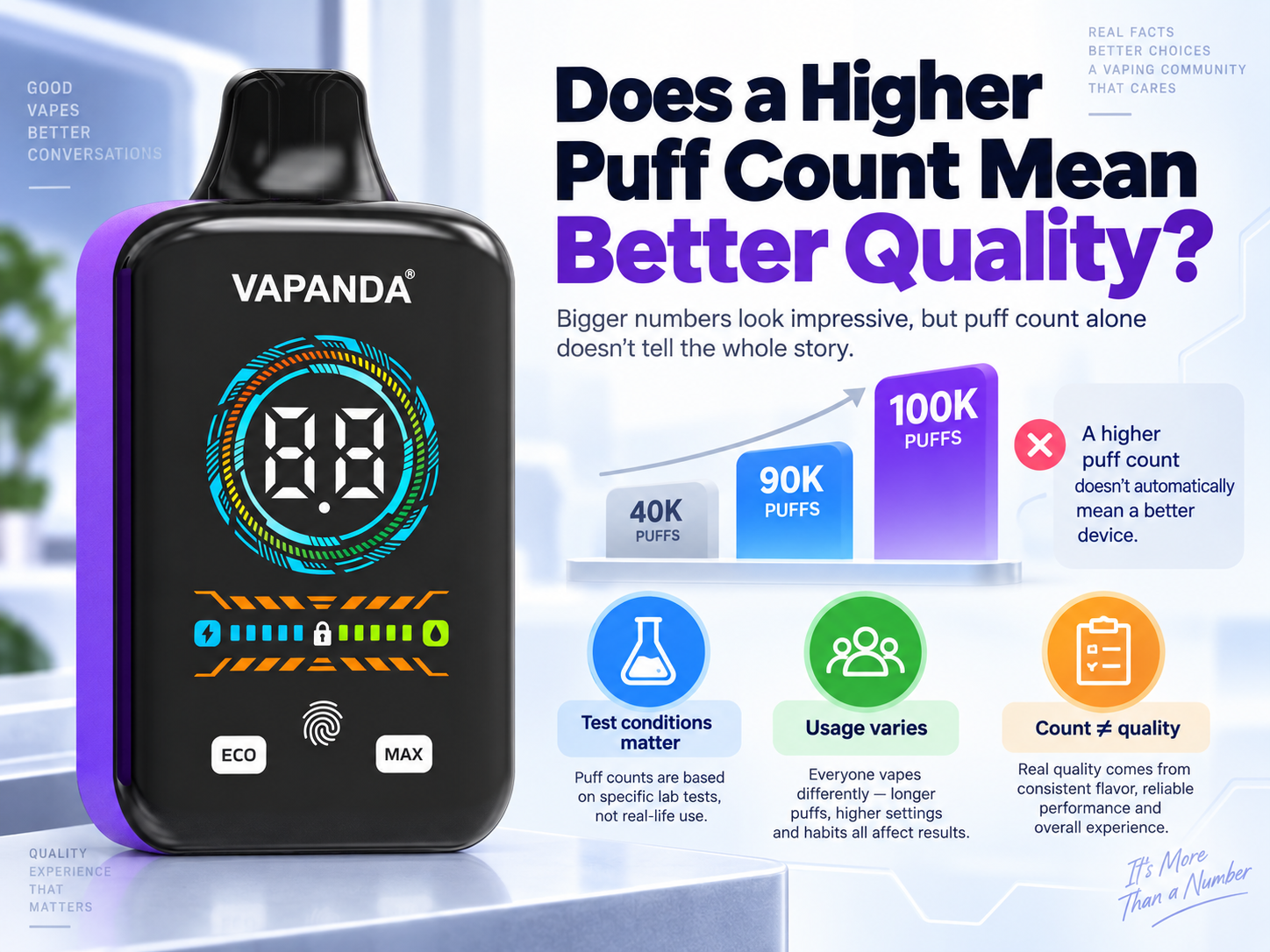
Does a Higher Puff Count Mean Better Quality?
No. A larger advertised puff count is a larger claim—not, by itself, evidence of better quality or a verified service life.
Labels such as 40K, 90K and 100K describe a claimed number of puffs. Without the underlying test report, it is not possible to establish how a particular figure was measured, whether it was extrapolated, or how representative it is of normal use.
Calling a number an “estimate” does not validate it. The useful questions are what was tested, how it was tested and what counted as the end of usable performance.
Puff Count at a Glance
| Question | What the evidence can establish |
|---|---|
| Does 100K guarantee 100,000 puffs for every user? | The label alone cannot establish that. |
| Does a higher number prove better quality? | No. Reliability, performance and safety need separate evidence. |
| Are puffs interchangeable between users? | No. Duration, volume and the interval between puffs vary. |
| Are all advertised counts comparable? | Only where relevant methods, configurations and endpoints are comparable. |
| Does a rechargeable battery validate the claimed total? | No. Charging capability is separate from liquid supply and usable device life. |
| Should someone continue using a faulty device to reach the number? | No. An advertised total is not an instruction to continue. |
What Does “100K Puffs” Actually Mean?
The wording indicates a claim about counted cycles, but it leaves important questions unanswered. Does it refer to one liquid-filled unit, several included reservoirs, or a different defined configuration? Were all cycles physically tested? Were recharging breaks included?
Even a genuine machine test needs a definition of one puff. Duration, air volume and the interval between activations are measurable variables; “one puff” is not a fixed quantity like one millilitre.
Research on adult e-cigarette users has documented substantial variation in these behaviours. That supports caution about translating machine counts directly into personal-use expectations. It does not verify a modern product’s advertised lifetime. 13
Why Do Real-World Results Vary?
Duration and Air Volume
A short activation and a longer activation may each be counted once, although they do not represent the same operating conditions. Two puffs of equal duration can also move different volumes of air.
Studies of puffing behaviour measure these variables separately precisely because a count alone loses information. Device design can also affect the patterns observed. 24
Operating Conditions
Power, liquid formulation and device construction can influence aerosol and nicotine output. For example, controlled laboratory research has shown that power and the liquid vehicle affected nicotine emissions under the conditions tested. This is evidence that configuration matters, not a formula for predicting the lifetime of a different device. 5
A rating obtained in one mode therefore cannot simply be assigned to another mode without supporting data.
Use Frequency and Recovery Intervals
Using the same number of puffs over a shorter time changes the sequence of operating and recovery periods. Whether that changes the final usable count, and by how much, must be established for the particular design.
More frequent use can shorten calendar life even without changing the total number of usable puffs. “Days of use” and “number of puffs” should not be treated as the same measurement.
How Should a Puff-Count Claim Be Tested?
Standardised analytical vaping-machine methods do exist. ISO 20768:2018 defines machine parameters and standard conditions; its published scope does not specify the product, the product’s operation or the liquid to be used. A 2025 amendment addresses puff-profile requirements. 6
Citing an analytical standard is not equivalent to showing that a specific advertised lifetime was achieved. A useful product report would disclose the following:
| Report item | Why it matters |
|---|---|
| Exact model, batch and configuration | Identifies what the result actually applies to |
| Measured count or extrapolated estimate | Separates observed results from projections |
| Puff duration, volume or flow, and interval | Defines the machine cycle |
| Mode and other operating settings | Makes the operating conditions identifiable |
| Liquid quantity and reservoir arrangement | Clarifies what supply was included |
| Charging procedure | Distinguishes one-charge performance from longer service life |
| Number of samples and result distribution | Shows whether the claim rests on one unit or repeated testing |
| Failure criteria and endpoint | Explains when counting stopped |
| Measurement uncertainty and exclusions | Makes limitations visible |
This is an editorial evidence checklist, not a statement that every listed item is mandated by ISO 20768.
Why the Endpoint Matters
A counter can keep recording activations without proving that each one meets a stated performance criterion. A test might end at liquid depletion, electrical cutoff or a predefined output threshold. These are different endpoints.
A lifetime report should explain which endpoint it uses and how faults are handled. Continuing to count after acceptable performance ends would answer a different question from the number of usable puffs.
Why 90K vs 100K Is Not a Quality Comparison
The arithmetic is straightforward: 100,000 is about 11.1% greater than 90,000. That is the difference between two stated numbers, not proof that one device is 11.1% better.
Even when two counts are verified using comparable methods, they describe performance against a defined endpoint. They do not independently establish sealing quality, electrical safety, consistency between units or long-term health effects.
This article does not validate either figure for any named brand. Product names and shop listings are not substitutes for test reports.
Why a Device Might Finish Earlier Than the Label Suggests
A shorter usable life could reflect different operating conditions, an individual fault, deterioration of a component, or an overstated or insufficiently explained claim. A puff label alone cannot distinguish these possibilities.
It is therefore inappropriate to assume that every shortfall is caused by the user. Comparing the device’s actual configuration with the disclosed testing conditions is more informative than relying on the printed total.
Do not try to reach an advertised count by continuing through persistent burnt taste, leakage or abnormal operation. For battery or charging concerns, stop using the device and follow its safety instructions; FDA warns that battery-related incidents can cause serious injury. 8
What a High Puff Number Does Not Prove
A high number is not evidence of constant flavour, consistent aerosol output, a particular nicotine dose, superior battery quality or greater safety. Each is a different claim with a different measurement requirement.
Nor can a puff count alone establish an equivalent number of cigarettes. Counted activations do not tell the reader how much aerosol or nicotine was delivered or absorbed.
What the Research Does—and Does Not—Support
The puffing studies cited here examine behaviour and measurement methods. They are useful background for understanding variability, but they are not endurance tests of current 90K or 100K products. The 2016 measurement-device study was funded by British American Tobacco, with authors employed within that group; that context should remain visible. 4
Older studies should also not be used to imply that no analytical standards exist today. Current methodology references and product-specific evidence serve different purposes.
Regulatory Context
A large puff claim does not establish whether a product can legally be marketed in a destination country. EU rules address matters including nicotine concentration, container design, notification, packaging and promotion—not simply the puff number on the label. 9
Frequently Asked Questions
Is every puff figure based on a laboratory test?
That cannot be assumed without the manufacturer’s method or report. A number might be measured, calculated or otherwise estimated; the basis should be stated.
Can a rechargeable device run out of liquid while the battery still works?
Yes. Electrical charge and liquid supply are different resources. Remaining battery charge is not evidence of remaining usable liquid or a serviceable heating component.
Does boost mode change the puff count?
It may change operating conditions and consumption. The size of any effect requires model-specific data; there is no universal percentage deduction.
Is a lower number necessarily more honest?
No. Transparency and appropriate evidence matter at any claimed total. A smaller unsupported claim remains unsupported.
Bottom Line
Puff count is a claim about usage capacity, not an overall quality score. Without a disclosed method, configuration and endpoint, a larger figure should not be treated as demonstrated capacity.
For adults of legal smoking or vaping age. Vaping is not risk-free, and nicotine is addictive. People who do not use tobacco or nicotine should not start. This article is not a product endorsement, instruction manual or health assessment.
Sources
- Kosmider et al. (2018): Circadian Puffing Behavior and Topography Among E-cigarette Users.
- Behar et al. (2015): Puffing topography and nicotine intake of electronic cigarette users.
- Robinson et al. (2015): Electronic Cigarette Topography in the Natural Environment.
- Cunningham et al. (2016): Development, validation and application of a device to measure e-cigarette users’ puffing topography. Industry-funded study; see its conflict-of-interest statement.
- Talih et al. (2020): Laboratory study of nicotine form, power and liquid vehicle.
- ISO 20768:2018: public scope and status.
- ISO 20768:2018/Amd 1:2025: amendment information.
- FDA: Vape battery fire and explosion precautions.
- European Commission: Electronic cigarettes.