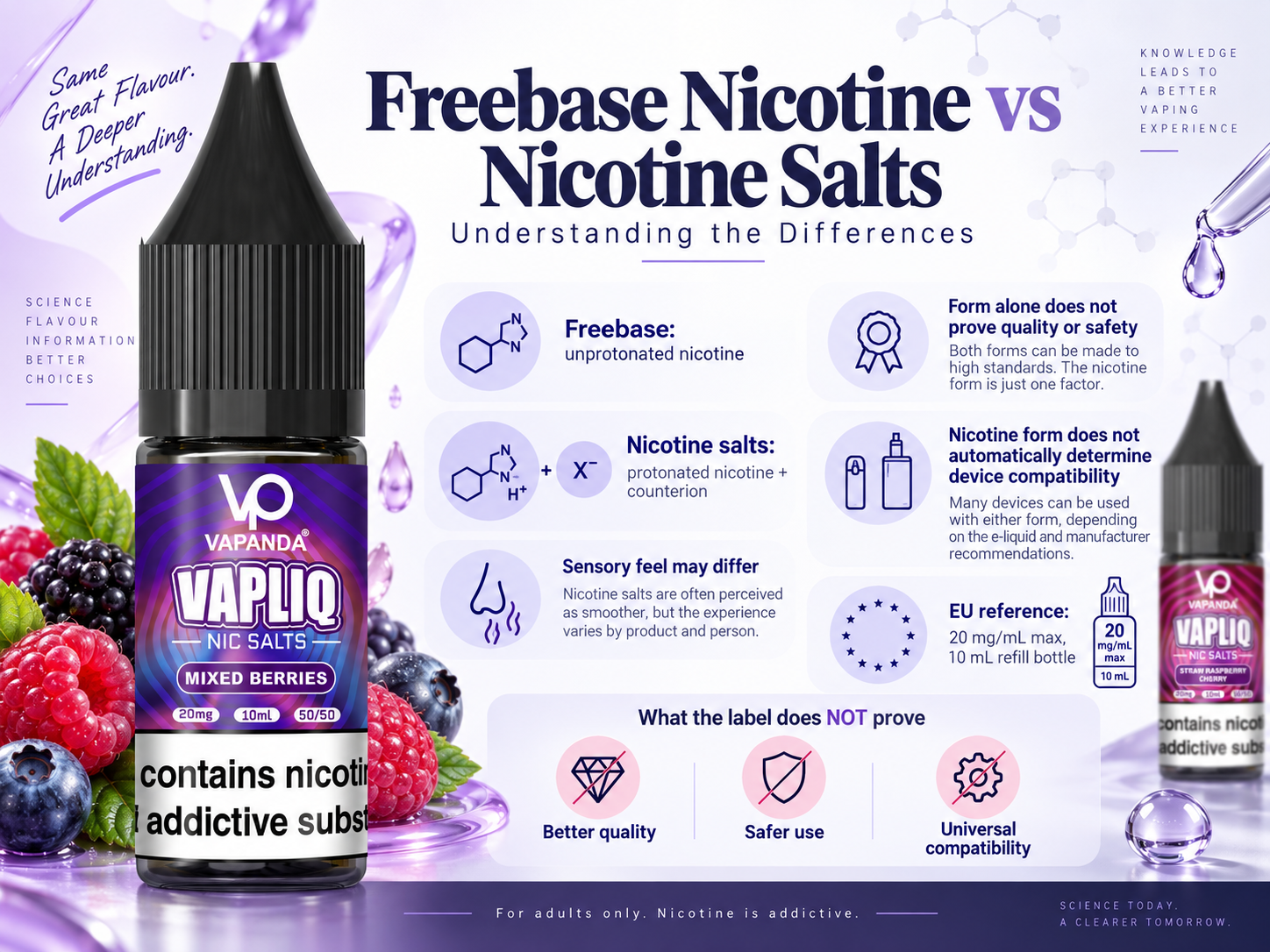
Freebase Nicotine vs Nicotine Salts: Understanding the Differences
Freebase nicotine and nicotine salts are different chemical forms of nicotine—not different guarantees of quality, compatibility or safety. Their central distinction is protonation: whether nicotine is present in its unprotonated form or associated with an added proton and a counterion. Commercial liquids can contain a mixture of forms. 1
That distinction can influence sensory effects and nicotine delivery. It does not justify simple rules such as “salts are always absorbed faster,” “freebase belongs only in high-power devices” or “nicotine salts cannot irritate the throat.”
This article explains what the terminology and available evidence support. It does not recommend a nicotine strength or encourage starting nicotine use.
What Is Freebase Nicotine?
Freebase nicotine is the unprotonated form of nicotine. The name describes a chemical state; it does not specify one extraction method or prove that ammonia was used in manufacturing.
In an e-liquid, the balance of nicotine forms depends on the formulation’s acid–base conditions. It is not necessarily accurate to assume that every liquid labelled “freebase” contains exclusively unprotonated nicotine. 1
Nicotine form also does not establish a built-in tobacco flavour, a fixed absorption speed or an appropriate device wattage. Those are separate questions that require further information.
What Are Nicotine Salts?
Nicotine salts contain protonated nicotine associated with an acid-derived counterion. Benzoic acid is one example used in studied formulations; the term “nicotine salt” does not identify a single recipe. 1
Descriptions based only on “high pH” and “neutral pH” can be misleading. PG/VG liquids are not simply aqueous solutions, and measurements made after adding water can alter the chemical conditions being measured. A salt label alone does not establish a universal pH value. 1
The relevant point is the balance of nicotine forms—not a promise that a liquid is chemically neutral, gentle or harmless.
Side-by-Side Comparison
| Question | Freebase-labelled liquid | Salt-labelled liquid |
|---|---|---|
| What does the term describe? | Nicotine formulation associated with its unprotonated form | Formulation containing protonated nicotine and a counterion |
| Is the nicotine form necessarily exclusive? | No; the formulation can contain a mixture | No; the degree of protonation can vary |
| Can sensory effects differ? | Yes; tested formulations can feel more harsh or bitter | Yes; tested formulations can feel less harsh |
| Does the label establish absorbed dose? | No | No |
| Does it determine PG/VG ratio? | No | No |
| Does it establish device compatibility? | No | No |
| Does it establish safety or legal compliance? | No | No |
The chemical and sensory distinctions are supported by formulation research and controlled studies. The limits in the table follow from keeping separate measurements and claims separate. 1
Throat Sensation: Less Harsh Is Not Harmless
A randomised trial found lower reported harshness and higher smoothness ratings for the salt formulations tested compared with freebase formulations. The researchers also noted limits on extending the results to other products and acids. 2
That is evidence of a sensory difference under studied conditions. It is not evidence that all nicotine salts eliminate irritation or make high nicotine exposure safe.
Sensory comfort is not a reliable measure of dose or health risk. A liquid that feels less harsh can still expose the user to substantial nicotine. Both the composition of the liquid and how the device is used matter. 2
Claims that one nicotine form always provides “cleaner fruit flavours” or a “natural earthy undertone” also go beyond what the category alone establishes. Flavour perception is not determined by the nicotine label in isolation.
Does Nicotine Salt Always Absorb Faster?
No universal absorption ranking can be inferred from the label alone. A 2024 crossover trial involving 72 adult e-cigarette users aged 21–25 found higher nicotine intake with salt-based formulations under its tested conditions. The authors identified limitations concerning participants and the device used. 3
This finding should not be turned into a promise that every nicotine salt reaches the bloodstream faster than every freebase liquid. Concentration, formulation, aerosol delivery, behaviour and study conditions all affect the comparison.
It is also important to distinguish nicotine emitted by a device from nicotine absorbed by a person. A separate machine study found no effect of nicotine form on emitted nicotine under its tested conditions, while power and the liquid vehicle did affect emissions. Those outcomes are not interchangeable with blood measurements in a human trial. 4
The conclusion is not that chemistry is irrelevant. It is that chemistry alone is insufficient to predict a person’s nicotine exposure.
Nicotine Form, Concentration and PG/VG Are Different Properties
“Salt” or “freebase” describes formulation chemistry. A concentration in mg/mL describes the labelled mass of nicotine per millilitre of liquid. PG/VG describes the proportions of propylene glycol and vegetable glycerine in the solvent mixture.
These fields answer different questions. A salt formulation is not automatically 50/50 PG/VG, and a freebase formulation is not automatically high-VG. A genuinely nicotine-free liquid contains neither form of nicotine; “0 mg/mL” should not be presented as a type of freebase nicotine.
The labelled concentration is not an absorbed dose per puff. Neither a concentration nor a solvent ratio, taken alone, establishes whether a formulation is appropriate for a particular device. Experimental work separating nicotine form from the liquid vehicle illustrates why these variables should not be conflated. 4
Device Compatibility and Maintenance
The exact device, pod or coil documentation should determine supported liquids and operating conditions. Generic rules based only on nicotine form cannot replace those instructions.
The same principle applies to maintenance claims:
| Claim | More accurate interpretation |
|---|---|
| “All pods must use 50/50 liquid” | Supported formulations are device-specific. |
| “Nicotine salts prevent leaking” | Nicotine form alone does not establish sealing or liquid-delivery performance. |
| “Every coil lasts 7–14 days” | A universal lifespan cannot be established without a defined product and usage conditions. |
| “Every pod should be filled to 80%” | The product’s fill marking and instructions determine its permitted fill level. |
| “A burnt taste proves the liquid ratio is wrong” | A symptom alone does not identify one cause. |
These are limits on generic troubleshooting, not alternative universal instructions. Do not attempt to correct an unexplained fault by changing nicotine strength, forcing open components or following an unverified online workaround.
EU Rules: Concentration Is Only One Requirement
Article 20 of the EU Tobacco Products Directive sets, for covered consumer products, a maximum nicotine concentration of 20 mg/mL, nicotine refill containers of no more than 10 mL, and cartridges or tanks of no more than 2 mL. It also imposes other requirements. 5
Meeting these numerical limits alone does not establish full compliance. The Directive does not prescribe a 50/50 PG/VG formulation or make that ratio a certification. Rules must be checked for the actual product and destination market. 5
These are product-market requirements, not recommended nicotine doses or universal restrictions on personal possession. Neither “TPD-compliant” nor “nicotine salt” should be used as a substitute for product-specific evidence.
Frequently Asked Questions
Are nicotine salts less addictive because they feel less harsh?
No. Reduced harshness is not proof of lower dependence risk. Human research has raised concerns about nicotine intake and dependence-related effects with the salt formulations studied. 3
Can freebase nicotine be used only in high-power devices?
No such restriction follows from the term itself. Formulation, concentration and the device’s instructions must be considered separately.
Does a 50/50 ratio prevent every dry hit or leak?
No. A liquid ratio cannot establish the condition of a seal, heating component or reservoir. No universal prevention claim is justified by the ratio alone.
Is mixing freebase and salt liquids automatically safe?
No general safety assurance can be made for unspecified products and ingredients. Compatibility and final composition cannot be established from those two labels alone. This article provides no mixing procedure.
How long do these liquids remain usable?
Neither nicotine form establishes a universal shelf life. Follow the product’s storage instructions and expiry or use-by information rather than assuming a fixed one- or two-year period applies to every formulation.
Bottom Line
Nicotine form can affect chemical and sensory behaviour, but it does not determine the whole product. Keep nicotine form, labelled concentration, solvent ratio, device compatibility, measured exposure and legal compliance separate.
A technically sound comparison recognises these distinctions without converting “less harsh” into “safer,” or a study result into a universal promise.
Adult-Use and Safety Notice
For adults of legal smoking or vaping age. Nicotine is addictive, and vaping is not risk-free. People who do not use tobacco or nicotine should not start. Keep liquids and devices away from children and pets. For health concerns or help stopping nicotine use, contact a qualified healthcare professional. This article is not medical advice or a product-specific safety assessment.
Sources
- Duell, Pankow and Peyton (2018): Free-Base Nicotine Determination in Electronic Cigarette Liquids by 1H NMR Spectroscopy. See also the published correction. Used here for the chemical distinction and measurement caveat, not individual sample values.
- Leventhal et al. (2021): Randomised trial of nicotine form and sensory effects.
- Cho et al. (2024): Crossover trial of nicotine form, concentration and flavour.
- Talih et al. (2020): Laboratory study of nicotine form, power and liquid vehicle.
- Directive 2014/40/EU, Article 20 — applicable product requirements.
- European Commission: Electronic cigarettes — notification, labelling and wider regulatory context.