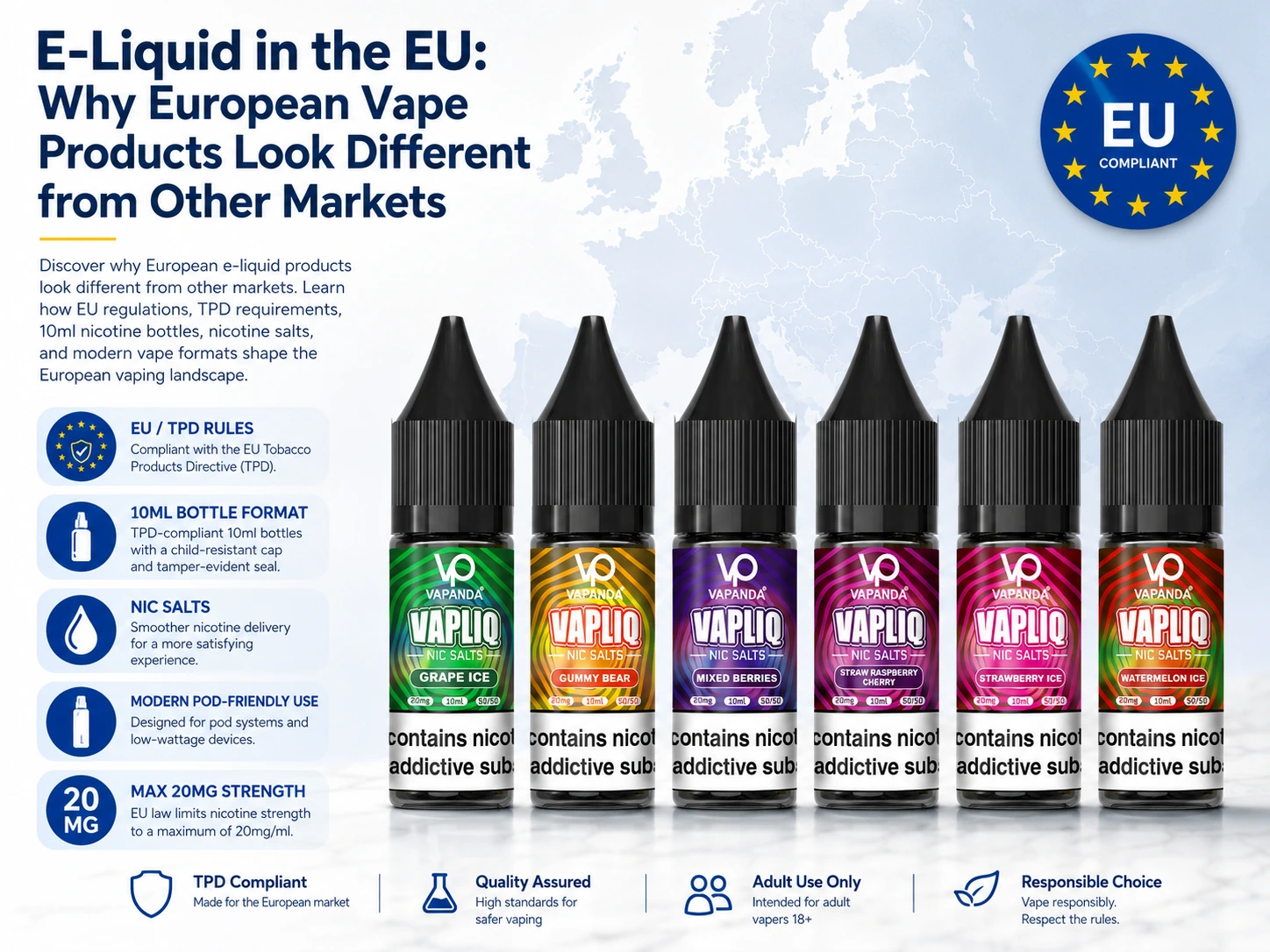
Discover why European e-liquid products look different from other markets. Learn how EU regulations, TPD requirements, 10ml nicotine bottles, nicotine salts, and modern vape formats shape the European vaping landscape.
Introduction
When people search for e-liquid online, they often find basic information about flavours, VG/PG ratios, nicotine strengths, or device maintenance.
However, one important question is often overlooked:
Why do e-liquid products sold in Europe look different from those available in other markets?
The answer is not only related to consumer preferences. The European e-liquid market has been shaped by regulation, product design, and changes in vaping technology.
The popularity of 10ml nicotine bottles, nicotine salt formulations, and pod-based devices is closely connected to the regulatory framework established across the European Union.
Understanding these differences helps explain why European vape products have developed their own characteristics compared with markets such as the United States and other regions.
What Is E-Liquid?
E-liquid is the liquid used in electronic cigarettes and vaping devices. When heated by a coil, it produces an aerosol that users inhale.
Most e-liquids contain:
- Propylene Glycol (PG) – commonly used to carry flavour ingredients and influence vapour characteristics.
- Vegetable Glycerin (VG) – a thicker liquid that contributes to vapour production.
- Flavourings – ingredients used to create different flavour profiles.
- Nicotine (optional) – added in products designed for adult users who choose nicotine-containing e-liquids.
Although the basic ingredients are similar worldwide, e-liquid products can look very different depending on local regulations and market conditions.
In Europe, nicotine-containing e-liquids are mainly influenced by the EU Tobacco Products Directive (TPD), together with additional national requirements.
Why 10ml Nicotine Bottles Are Common in Europe
One of the most recognisable features of the European e-liquid market is the widespread use of 10ml nicotine-containing refill bottles.
This format is mainly the result of EU regulations rather than simply a packaging preference.
Under the EU Tobacco Products Directive, nicotine-containing refill containers placed on the EU market must meet specific requirements, including:
- Maximum bottle size: nicotine-containing refill liquids cannot exceed 10ml.
- Maximum nicotine concentration: nicotine strength cannot exceed 20mg/ml.
- Packaging requirements: products must include required warnings, instructions, and safety features.
- Notification requirements: manufacturers and importers must submit product information according to applicable regulations.
These requirements have influenced how manufacturers develop and distribute nicotine-containing e-liquids for European markets.
As a result, 10ml bottles have become a defining format for many EU nicotine e-liquid products.
Why European and US E-Liquid Products Look Different
Consumers comparing e-liquid products from different regions often notice differences in:
- Bottle sizes
- Nicotine strengths
- Available formats
- Device compatibility
These differences are mainly caused by different regulatory approaches.
In the European Union, the TPD creates a common framework for nicotine-containing e-cigarette products, including requirements related to nicotine concentration, refill containers, packaging, and notification.
In the United States, e-cigarette products are regulated under the FDA tobacco product framework, which follows a different approach.
Product formats may vary depending on product category, manufacturer status, and applicable requirements.
EU vs US E-Liquid Market Comparison
| Feature | European Union | United States |
|---|---|---|
| Nicotine-containing refill bottles | Maximum 10ml under TPD requirements | Different bottle formats may exist depending on product category |
| Maximum nicotine concentration | Maximum 20mg/ml under the TPD framework | No equivalent nationwide limit matching the EU approach |
| Main regulatory framework | EU Tobacco Products Directive (Directive 2014/40/EU) | FDA tobacco product regulations |
| Common formats | 10ml nicotine e-liquids, refillable pods, pre-filled systems, disposable devices | Different formats across multiple product categories |
This comparison does not mean one market is better than another.
It shows how different regulatory systems influence the products available in each region.
EU, US, and UK: Different Regulatory Paths
Although the UK previously followed EU tobacco product rules, it now operates under its own national regulatory framework.
Many product requirements remain similar to the TPD approach, but regulatory processes are managed separately.
This creates three related but different markets:
| Region | Main Characteristics |
|---|---|
| European Union | TPD-based framework with shared requirements across member states |
| United Kingdom | Similar restrictions in some areas but separate national regulation |
| United States | Different regulatory pathway under the FDA framework |
These differences help explain why similar e-liquid categories may appear differently across regions.
Why Nicotine Salts Became Popular in Europe
The growth of nicotine salt e-liquids is closely connected to the development of compact vaping devices, especially pod systems and pre-filled products.
Traditional freebase nicotine has been widely used in e-liquids for many years.
However, different nicotine formats are designed for different device types and user preferences.
Nicotine salt formulations are commonly found in lower-power devices and pod-based systems, where the liquid format is designed to work with compact hardware.
They are widely used in:
- Refillable pod systems
- Compact vape devices
- Pre-filled pod products
- Disposable vape devices
Within the EU market, where nicotine-containing e-liquids are limited to a maximum of 20mg/ml under the TPD framework, nicotine salts have become one of the common e-liquid categories.
How Device Design Influences E-Liquid Choice
Modern vaping products are increasingly designed around complete systems, where the device, coil technology, and e-liquid format are considered together.
Different devices are generally associated with different types of e-liquid:
| Device Type | Common E-Liquid Choice |
|---|---|
| Refillable pod systems | Nicotine salt e-liquids and balanced VG/PG formulations |
| Closed pod systems | Pre-filled nicotine salt cartridges |
| High-power refillable devices | Lower nicotine freebase liquids with higher VG content |
| Disposable vape devices | Pre-filled e-liquid designed for the integrated coil system |
This explains why the same e-liquid may perform differently depending on the device being used.
A formulation designed for a high-power tank device is not necessarily intended for a small pod system, and compact devices often use e-liquid formats developed specifically for lower-power operation.
The relationship between e-liquid and hardware has become an important part of the modern vape market.
10ml Nicotine E-Liquids vs Shortfills in Europe
Although 10ml nicotine e-liquids are a major category in Europe, they are not the only available format.
Another important category is shortfill e-liquid.
Shortfills are generally larger bottles containing nicotine-free e-liquid.
Since the EU 10ml limit applies specifically to nicotine-containing refill containers, nicotine-free products can be available in larger formats where permitted by local regulations.
This has created two different product structures:
10ml Nicotine E-Liquids
- Ready-to-use nicotine products
- Commonly available in European vape shops
- Often used with refillable pod systems
Shortfill E-Liquids
- Larger bottles containing nicotine-free liquid
- Used by some consumers who prefer larger formats
- May be combined with nicotine shots in certain markets where permitted
The coexistence of these formats shows how the European e-liquid market has adapted to regulatory requirements while maintaining different consumer options.
What EU Vape Shops Commonly Stock
Product selections vary between countries, but many European vape retailers share similar categories.
A typical EU vape shop may offer:
- 10ml nicotine e-liquids
- Refillable pod systems
- Closed pod cartridges
- Disposable vape products
- Nicotine-free shortfills
- Accessories for refillable devices
The influence of the TPD means many nicotine-containing products follow similar requirements for packaging and product information across Europe.
However, national rules and consumer preferences can still affect:
- Product availability
- Flavour options
- Popular device categories
For examples of EU-focused vape product categories and device formats, manufacturers such as VAAPEE organise products by different device types and market needs.
Common Misconceptions About European E-Liquid
Misconception 1: E-Liquid Only Means Refill Bottles
Many people associate e-liquid only with standalone bottles.
However, modern vape products use several formats.
E-liquid can be found in:
- Refillable bottles
- Pre-filled pod systems
- Closed cartridges
- Disposable vape devices
The difference is not whether e-liquid exists, but how it is delivered to the user.
Misconception 2: Higher Nicotine Strength Means a Better Product
Nicotine strength does not determine whether an e-liquid is better or worse.
Different nicotine levels are designed for different devices and preferences.
For example:
- Lower nicotine freebase liquids are commonly associated with some higher-power refillable devices.
- Nicotine salt liquids are commonly used in compact pod systems.
Within the EU, nicotine-containing e-liquids cannot exceed 20mg/ml under the TPD framework.
Misconception 3: Disposable Vapes and E-Liquid Are Separate Categories
Disposable vapes are sometimes discussed as a separate category from e-liquid.
In reality, disposable devices contain pre-filled e-liquid integrated into the product.
The main difference is the delivery method:
- Refillable systems require users to add liquid manually.
- Disposable and closed systems contain liquid already filled inside the device.
How EU Regulations Influence Product Design
The impact of the TPD goes beyond bottle size.
Companies placing nicotine-containing e-cigarettes and refill liquids on the EU market must consider requirements related to:
- Product notification
- Ingredient information
- Packaging standards
- Health warnings
- Consumer instructions
- Safety requirements
These rules have influenced how manufacturers design, package, and distribute nicotine-containing vape products.
Although the TPD provides a shared framework, individual EU countries may introduce additional national requirements.
This means product availability and restrictions can still vary between markets.
Where E-Liquid Fits in the Modern EU Vape Market
Today, e-liquid connects several major vape product categories:
- Disposable vape devices
- Refillable pod systems
- Closed pod systems
- 10ml nicotine e-liquids
- Nicotine-free shortfills
The European market has developed beyond the simple idea of only buying a bottle of liquid.
Many modern vape products are designed as complete systems where:
- Device design
- Coil technology
- Nicotine format
- E-liquid characteristics
work together.
This is one of the main reasons European vape products can look different from products in other regions.
FAQ
What is e-liquid?
E-liquid is the liquid used in electronic cigarettes and vaping devices.
It typically contains propylene glycol (PG), vegetable glycerin (VG), flavourings, and optionally nicotine.
Why are nicotine e-liquids sold in 10ml bottles in the EU?
Under the EU Tobacco Products Directive (TPD), nicotine-containing refill containers cannot exceed 10ml, and nicotine concentration cannot exceed 20mg/ml.
What is the difference between nicotine salts and freebase nicotine?
Both are forms of nicotine used in e-liquids.
Nicotine salt e-liquids are commonly used in compact pod systems, while freebase nicotine has traditionally been used in many refillable tank devices.
Why are shortfill e-liquids sold in larger bottles?
The EU 10ml limit applies specifically to nicotine-containing refill containers.
Shortfill products are generally nicotine-free e-liquids, allowing larger bottle formats where permitted by applicable regulations.
Do disposable vapes contain e-liquid?
Yes.
Disposable vape devices contain pre-filled e-liquid integrated into the device.
The difference is that the liquid is already contained inside the product instead of being manually added by the user.
Is e-liquid regulated in the European Union?
Yes.
Nicotine-containing e-liquids are regulated under the EU Tobacco Products Directive (Directive 2014/40/EU), which establishes requirements related to nicotine concentration, refill container size, product notification, packaging, and labelling.
However, individual countries may introduce additional national requirements, meaning regulations and product availability can vary between markets.
Conclusion
European e-liquid products look different from those in many other markets because regulation and product development have evolved together.
The widespread use of 10ml nicotine bottles, the popularity of nicotine salt formulations, and the growth of pod-based devices are all connected to the structure of the EU market.
Compared with regions such as the United States, Europe has developed a distinct e-liquid landscape shaped by its own regulatory framework and market conditions.
While vaping products continue to change, e-liquid remains the common element behind many major categories, from refill bottles to pre-filled systems.
Understanding these differences helps explain why European vape products have developed their own characteristics compared with other markets.
Disclaimer
This article is provided for informational purposes only.
Vaping products may contain nicotine, which is an addictive substance.
Products are intended for adult users and should be used according to applicable laws and regulations.
They are strictly intended for adults aged 21 or above and must be used in accordance with local laws and regulations.
Availability and regulations may vary by country within the EU.