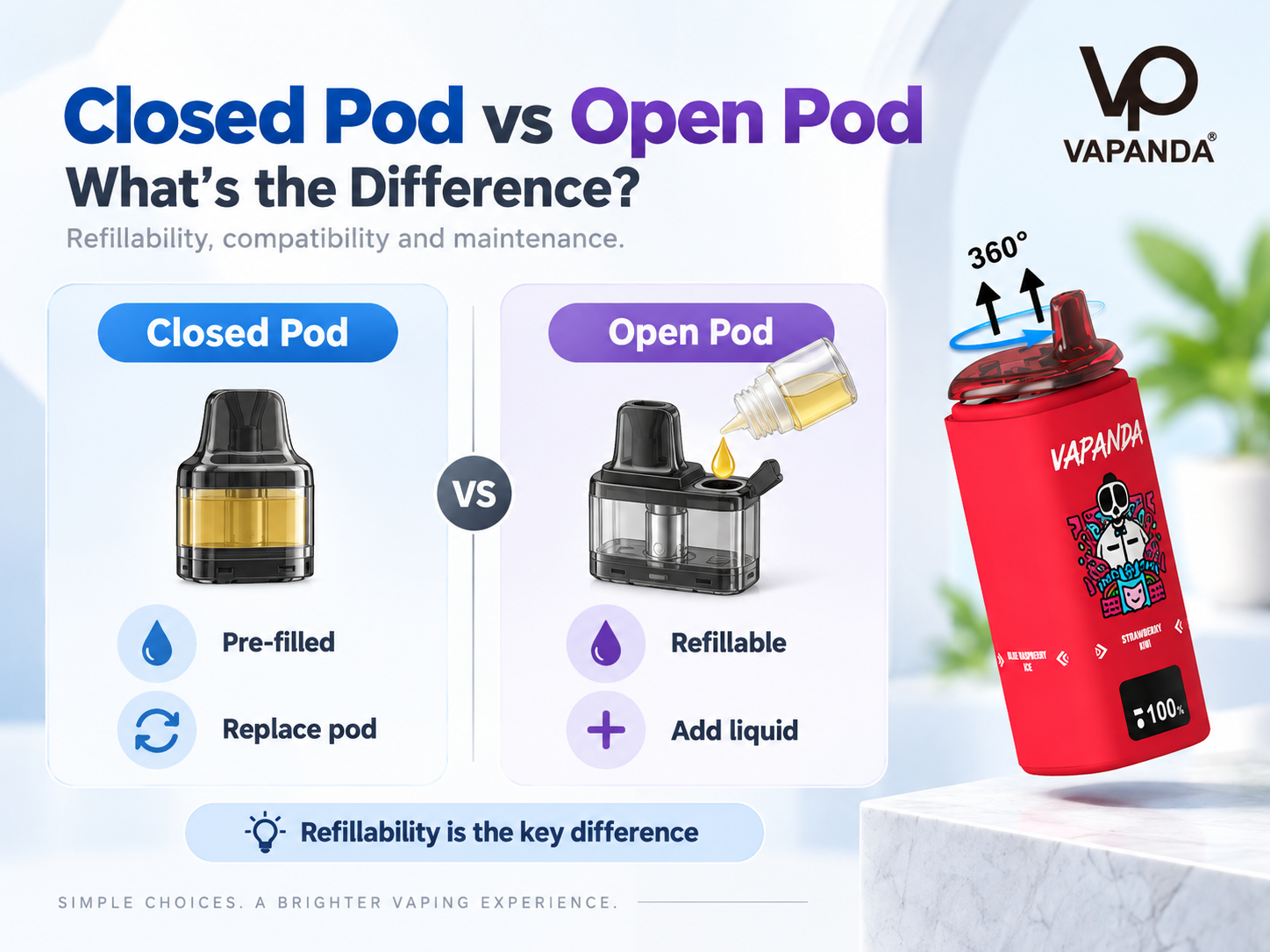
Closed Pod vs Open Pod: What's the Difference?
The main difference is whether the pod is designed to be refilled by the user. A closed pod normally comes pre-filled and is replaced when depleted. An open pod has a reservoir intended for refilling. Both formats can use a rechargeable battery device. 1
“Open” does not mean universal compatibility, and “closed” does not necessarily mean the entire device is disposable. These distinctions matter more than the shape of the device or the name printed on its packaging.
This article explains the terminology and its practical limitations. It does not recommend starting to vape or endorse a particular product.
Closed Pod vs Open Pod at a Glance
| Feature | Closed pod | Open pod |
|---|---|---|
| Liquid supply | Normally supplied in a pre-filled pod | Added to a refillable reservoir |
| Intended user refilling | No | Yes |
| Battery unit | May be rechargeable and reusable | Normally rechargeable and reusable |
| Depleted liquid | Pod is normally replaced | Reservoir may be refilled within the product's instructions |
| Worn heating component | Normally requires pod replacement | May require pod replacement or a separate coil, depending on design |
| Pod compatibility | Specific to supported devices | Can also be specific to supported devices |
| Handling responsibilities | Charging, inspection and pod replacement | Those responsibilities plus handling bottled liquid and refill seals |
| What the category does not establish | Safety, reliability or legal availability | Safety, reliability or legal availability |
The table describes common formats, not a certification standard or a guarantee about every model. The manufacturer’s documentation determines the intended operation of a particular device.
What Is a Closed Pod System?
A closed pod system normally uses a pre-filled cartridge that is not intended for user refilling. The battery section can remain in service while the cartridge is replaced. This differs from a disposable device whose liquid-containing assembly is not intended to be replaced for continued use. 1
A pod being physically removable does not make it refillable. Equally, the possibility of forcing open a sealed cartridge does not make that an intended or supported operation.
The liquid formulation is determined before the pod reaches the user. Available flavours and nicotine concentrations depend on the compatible cartridge range and the market in which it is supplied. The word “closed” does not establish that the liquid has been independently tested or that the product is legally available everywhere.
What Is an Open Pod System?
An open pod system has a reservoir intended to accept compatible bottled e-liquid. The pod may contain an integrated heating component or a separately replaceable coil. These are different maintenance arrangements, even though both can be described as open systems.
A useful distinction is:
Refillability describes liquid access. Compatibility describes which components and formulations the device supports.
A refillable pod can still be proprietary to one device family. “Open system” therefore should not be read as “accepts any pod, coil or e-liquid.” Nor does the label imply adjustable power or airflow; those are separate features.
E-Liquid Options and Compatibility
Closed pods limit liquid choice to the formulations supplied in compatible pre-filled cartridges. Open pods separate the reservoir from the bottle used to fill it, but that separation does not remove compatibility limits.
For an existing device, the relevant reference is its exact model and pod or coil specification—not a generic statement that all pods require one liquid ratio. Likewise, nicotine form, nicotine concentration and the PG/VG solvent ratio describe different properties. One does not automatically establish the others.
General online advice should not override the product’s instructions. If the supported formulation or component is unclear, the manufacturer should clarify it before the device is used. FDA battery-safety guidance similarly stresses understanding the instructions for the specific device. 2
Which Requires More Maintenance?
Closed pods remove the routine task of pouring bottled liquid into the reservoir. They do not remove the need to inspect the device, keep electrical connections dry or recognise damaged components.
Open pods add responsibility for the refill opening, reservoir and seals. An integrated-coil pod and a replaceable-coil pod may also require different actions when their heating components deteriorate.
These differences concern the number and type of handling tasks. They do not establish that one format will always leak less, last longer or be safer. There is no device-independent replacement interval established by the words “open” or “closed.”
Do not continue using a leaking, damaged or abnormally hot device simply because it still activates. Follow its fault instructions rather than trying to compensate by altering settings or modifying components.
Cost Considerations
The two formats have different recurring expenses. Closed systems normally involve replacement pre-filled pods. Open systems involve bottled liquid and replacement pods or coils, as applicable.
A fair accounting comparison would use the same period and include:
Total recorded cost = device cost + liquid or pre-filled pods + replacement components.
Actual replacement frequency matters. Comparing the price of one pre-filled pod with one empty refillable pod leaves out the liquid in the latter case. Comparing advertised puff totals without compatible test conditions creates another mismatch.
Without local prices and actual consumption records, neither format can responsibly be described as universally cheaper. This is a limit on the comparison, not a recommendation to purchase either format.
Flavour Selection and Device Control
A closed system’s available formulations are tied to its compatible pod range. An open system may accommodate a broader set of manufacturer-supported liquids. That difference in selection does not prove better flavour quality or lower health risk.
Similarly, “more control” is not the same as “better engineering.” Adjustability, sealing quality, electrical protection and manufacturing consistency require their own evidence. They cannot be inferred from refillability alone.
Pod Systems and European Regulations
EU rules address product notification, packaging, safety and other requirements; the European Commission also identifies restrictions on cross-border advertising and promotion. An “open” or “closed” label is not proof of compliance. 3
Europe is not a single legal jurisdiction. A product or claim needs assessment for its destination market. This article does not certify any device, seller or website as compliant.
Frequently Asked Questions
Does “system-specific” mean “closed pod”?
No. A system-specific pod can still be designed for refilling. Compatibility and refillability answer different questions.
Is a closed pod the same as a disposable vape?
No. A closed-pod device can retain a rechargeable battery unit while its pre-filled pod is replaced. Some disposable devices are also rechargeable, but charging does not make their liquid reservoir refillable. 1
Does an open pod accept every e-liquid?
No. The term identifies a refillable reservoir, not universal formulation compatibility. The exact device documentation remains necessary.
Can a sealed closed pod be refilled anyway?
A sealed cartridge should not be opened or modified merely because it appears physically possible. That is different from using a reservoir expressly designed for refilling.
Is either format automatically safer?
No safety ranking follows from these category labels. Vaping involves exposure to aerosol, and nicotine-containing products carry addiction risks. 1
Bottom Line
Closed versus open is primarily a distinction about intended refilling—not overall quality. Keep refillability, component compatibility, battery reuse, maintenance and regulatory status separate when interpreting a product description.
For disposal, do not assume either format belongs in household recycling. Follow the local arrangements for devices containing batteries and residual nicotine; EPA explains why these materials require special care. 4
Adult-Use and Safety Notice
This information is intended for adults of legal smoking or vaping age. Vaping is not risk-free, and nicotine is addictive. People who do not use tobacco or nicotine should not start. Keep devices and liquids away from children and pets. This article is not a product instruction manual or medical advice.
Sources
- CDC: About E-Cigarettes (Vapes) — basic device categories and aerosol information.
- FDA: Tips to Help Avoid Vape Battery Fires or Explosions — device-specific instructions and battery handling.
- European Commission: Electronic cigarettes — EU product requirements and advertising context.
- US EPA: Safe disposal of e-cigarettes — battery and residual-nicotine disposal considerations.